Silent
Silent provides the tools for seekers to recognize their path and enables self-reliance for spiritual and magickal growth.
Seekers gain insight from his work and find their inner calm from his ability to listen and help others reflect.

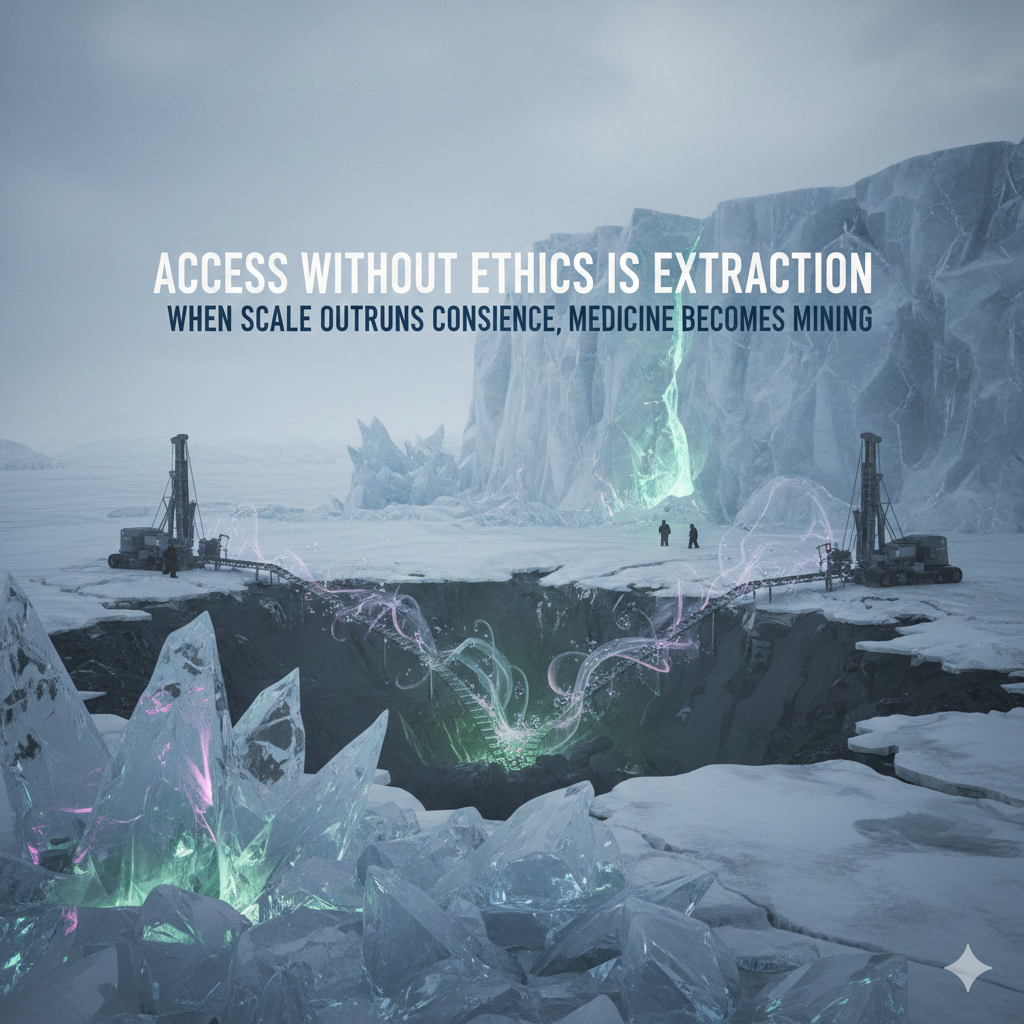
When scale outruns conscience, medicine becomes mining.
Top of Mind
“Access” has become the most persuasive word in the modern psychedelic movement. It is spoken with moral urgency and framed as justice: access to healing, access to care, access to consciousness itself. And at face value, that argument is not wrong. Psychedelics have demonstrated profound therapeutic potential, especially for trauma, depression, end-of-life anxiety, and moral injury.
But here is the hard truth leaders must confront:
When access expands faster than ethical infrastructure, psychedelics cease to be medicine and become a new form of resource extraction—this time from the psyche.
This is not a hypothetical risk. It is a structural one.
How “Access” Became the Dominant Moral Argument
Movements mature in stages. Early on, they fight for legitimacy. Later, they fight for scale.
In the psychedelic space, access has replaced wisdom as the primary moral currency. If something increases availability—more clinics, more providers, more indications—it is assumed to be good. Hesitation is framed as obstruction. Governance is labeled gatekeeping. Ethics are treated as a brake pedal in a race we are told cannot slow down.
But history is clear: scale without stewardship always produces harm—even when intentions are pure.
We have seen this before in pharmaceuticals, in digital health, in social media, and in fintech. The rhetoric of “democratization” is often used to justify speed, while the costs of that speed are quietly externalized onto individuals.
The Hidden Asymmetry of Risk
One of the least discussed issues in psychedelic commercialization is risk asymmetry.
Institutions carry reputational risk.
Individuals carry psychological, spiritual, and existential risk.
When a psychedelic experience goes poorly, the institution investigates protocols. The individual lives with fragmentation, destabilization, or retraumatization—sometimes for years. There is no malpractice policy that repairs a shattered meaning structure. No refund for a spiritual rupture.
This asymmetry matters because it shapes incentives. Organizations are rewarded for throughput, utilization, and growth. Individuals are asked to trust systems that often lack longitudinal accountability.
If you control scale, you inherit responsibility.
Responsibility does not end at informed consent.
Parallels to Early Digital Health and Subprime Insurance
The pattern is familiar.
Early digital health platforms promised empowerment and access. What followed was data extraction, fragmented care, and algorithmic opacity. Subprime insurance expanded “coverage” while obscuring risk, transferring systemic fragility onto those least equipped to absorb it.
Psychedelics are vulnerable to the same failure mode—but with deeper consequences. These are not neutral tools. They act directly on meaning-making, identity, and worldview. They open psychological terrain that cannot be safely abandoned after a single integration session.
To treat psychedelic access as a transactional service is to misunderstand its power—and to repeat past mistakes with far higher stakes.
Why Consent Without Context Is Insufficient
“Informed consent” is often cited as the ethical safeguard. It is necessary—but it is not sufficient.
Consent assumes the individual can accurately evaluate risk. Psychedelics, by definition, alter perception, judgment, and self-concept. Asking someone to consent to outcomes they cannot yet imagine is ethically thin unless the surrounding system provides context, containment, and continuity.
Context includes:
· Cultural framing (What does this experience mean?)
· Preparation (What frameworks will hold what arises?)
· Integration over time (Who walks with you after the peak?)
· Governance (Who is accountable if things unravel?)
Without this, consent becomes a checkbox—legally useful, morally hollow.
Ethics Is a System, Not a Personal Virtue
The most dangerous myth in this space is that ethics are a matter of individual intention. They are not.
Ethics live in systems:
· In incentive structures
· In training standards
· In integration models
· In long-term follow-up
· In how harm is acknowledged and repaired
Good people inside bad systems still produce bad outcomes. We know this. Pretending otherwise is how extraction hides behind compassion.
If your business model depends on volume, speed, or minimal touch, you are not practicing medicine—you are harvesting experience.
And experience, once extracted without care, leaves scars.
Actionable Takeaways for Leaders
If you are building, funding, regulating, or scaling in this space:
· Condition access on governance. No scale without standards, oversight, and accountability.
· Design for longitudinal care, not episodic transactions.
· Align incentives with patient wholeness, not throughput.
· Treat integration as infrastructure, not an add-on.
· Measure harm honestly—and respond to it publicly.
Ethics must be engineered, not assumed.
A Weekly Reflection
Ask yourself—brutally and honestly:
If this system scaled 10× tomorrow, who would carry the risk?
And would you be willing to carry it with them?
Because access without ethics is not liberation.
It is extraction—just refined enough to look like progress.
Onward.
ABOUT THE AUTHOR

Silent
Silent provides the tools for seekers to recognize their path and enables self-reliance for spiritual and magickal growth.
Seekers gain insight from his work and find their inner calm from his ability to listen and help others reflect.