Silent
Silent provides the tools for seekers to recognize their path and enables self-reliance for spiritual and magickal growth.
Seekers gain insight from his work and find their inner calm from his ability to listen and help others reflect.

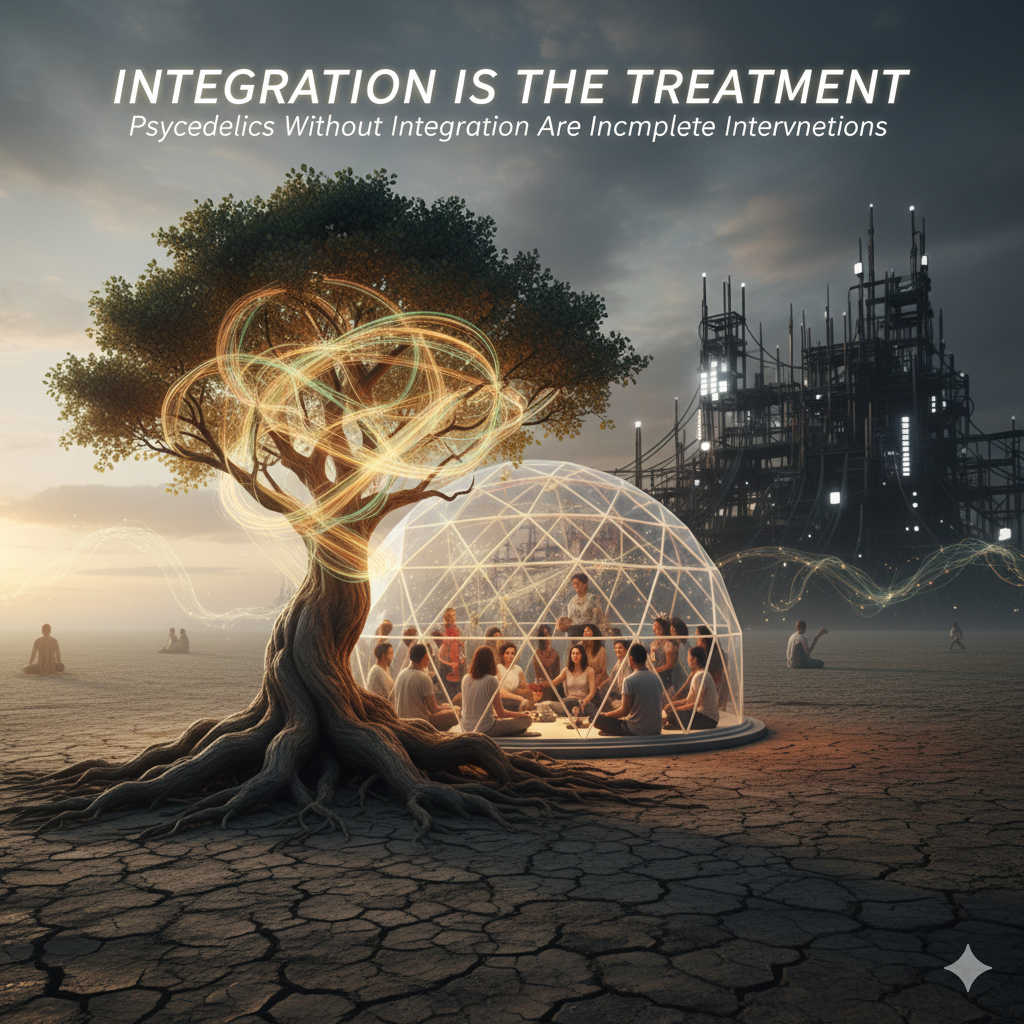
Thesis: Psychedelics without integration are incomplete interventions that externalize risk onto patients, families, and communities.
There is a quiet but consequential error being normalized in psychedelic care: the idea that the experience is the treatment, and integration is an optional add-on. This framing may be convenient for business models, regulatory shortcuts, and throughput metrics, but clinically, ethically, and spiritually, it is false.
Integration is not ancillary. It is not a postscript. It is not a wellness upgrade.
Integration is the treatment.
As clinicians and providers standing at the frontier of medicine, we must be willing to say the hard thing plainly: when integration is underfunded, under-designed, or outsourced to chance, we are shifting risk away from institutions and onto patients, and, by extension, onto their families and communities.
How Integration Was Sidelined to Preserve Margins
The current psychedelic care ecosystem did not sideline integration accidentally. It did so structurally.
Short-duration encounters are easier to price, easier to standardize, and easier to scale. They map cleanly onto existing fee-for-service logic. Integration, by contrast, is longitudinal, relational, and difficult to compress into neat billing units. It requires continuity, trained clinicians, and time horizons that extend beyond the dosing room.
So instead, integration became a “service line.” Optional. Often external. Sometimes reduced to a handout, a group call, or a referral list.
This is not neutral design. It is economic triage.
When organizations optimize for experience delivery rather than outcome stewardship, the system quietly offloads complexity onto the patient’s nervous system. The work still happens, but now it happens alone, at home, without containment.
The False Separation of “Experience” and “Outcome”
From a clinical perspective, separating psychedelic experience from outcome is like separating surgery from rehabilitation and calling the incision the cure.
Psychedelic states are destabilizing by design. They loosen cognitive defenses, disrupt identity narratives, and open emotional material that has often been compartmentalized for survival. This is not pathology, it is mechanism.
But mechanism without containment is volatility.
Outcome does not emerge from insight alone. It emerges from meaning-making over time, from relational mirroring, from somatic re-patterning, and from behavioral integration into daily life. Without these processes, insight decays, or worse, becomes disorganizing.
Clinicians know this pattern well: the patient who had a “powerful experience” but cannot translate it into stable functioning; the family member who reports increased emotional lability; the community that absorbs the downstream effects of someone opened but unsupported.
This is not failure of the medicine.
It is a failure of the model.
Long-Tail Psychological Destabilization
The most serious risks in psychedelic care rarely show up in adverse event reports. They show up months later.
Long-tail destabilization may include:
· Identity diffusion rather than consolidation
· Increased anxiety or derealization
· Spiritual bypassing masquerading as growth
· Fractures in intimate or professional relationships
· Difficulty re-entering structured environments (work, parenting, caregiving)
These outcomes are not always dramatic, but they are cumulative. And they disproportionately affect patients without strong relational, financial, or community scaffolding.
When integration is absent, the system quietly relies on informal caregivers, partners, friends, therapists outside the model, to absorb the load. This is not trauma-informed care. It is risk displacement.
Why Insurers Are Already Paying Attention
Payers are not interested in mystical experiences. They are interested in cost curves.
They are already tracking what happens when high-intensity interventions are followed by inadequate longitudinal support: relapse, utilization spikes, increased outpatient mental health costs, and in some cases, disability claims.
From a payer perspective, the question is not “Was the experience meaningful?”
It is “Did this intervention reduce downstream risk?”
Integration is where risk is either amortized, or compounded.
As reimbursement frameworks evolve, organizations that cannot demonstrate continuity, outcome durability, and longitudinal care pathways will struggle to justify coverage. The market signal is clear: episodic intensity without sustained containment is financially unattractive.
Integration as Longitudinal Care
True integration is not a session. It is a care arc.
It includes pre-experience preparation, post-experience meaning-making, somatic regulation, relational repair, and iterative reflection over time. It recognizes that transformation unfolds in phases, not moments.
Clinically, this means designing care models that honor:
· Continuity of therapeutic relationship
· Clear handoffs and shared language across providers
· Time horizons measured in months, not days
· Integration as a skilled clinical discipline, not peer support alone
Spiritually, it means acknowledging that opening the psyche without guiding its reorganization is not liberation, it is exposure.
Call to Action
To clinicians, providers, founders, and funders:
Stop funding experiences.
Start underwriting continuity.
Design for outcomes, not moments.
Contain the medicine with care equal to its power.
If we do not insist that integration is the treatment, the system will continue to externalize its costs, onto patients least equipped to bear them, and onto communities that never consented to the risk.
Tone at the top matters.
This is one place where clarity is not optional.
ABOUT THE AUTHOR

Silent
Silent provides the tools for seekers to recognize their path and enables self-reliance for spiritual and magickal growth.
Seekers gain insight from his work and find their inner calm from his ability to listen and help others reflect.