
Four weeks before Samhain, a recent study of grief technology and a 4,000-year-old household ritual ask the same question: where does love go when its person has died?

A new study of American religious life shows belief eroding even inside the tradition best known for keeping its people — and asks what's actually left once certainty goes. On September 22nd, Pew Research Center published one of the more quietly startling religion studies of the year, and it isn't about a fringe group or a sect nobody expected to hold together. It's about the Church of Jesus Christ of Latter-day Saints — a faith practically famous for how thoroughly it keeps its own. In 2007, seven in ten Americans raised Mormon still identified as Mormon in adulthood. By 2023–24, that number had fallen to fifty-four percent. Nearly a third of those raised in the faith now describe themselves as atheist, agnostic, or "nothing in particular" — double the share sixteen years earlier. Even among those who stayed, certainty thinned: belief in God "without doubt" dropped from ninety percent to seventy-six, daily prayer from eighty-two to seventy-three. I want to handle this data carefully. It's easy to hear "church retention falls" as bad news for the faithful, or quiet vindication for everyone else. Both readings miss the point. LDS retention, even diminished, still outperforms most American denominations. This isn't a story about one institution losing its grip. It's a story about certainty tested under close to the best conditions available to it — strong community, generational continuity, real doctrinal coherence — and still, gradually, coming apart at the seams. If it can happen there, the architecture holding up anyone's inherited certainty is less permanent than it looks from inside it. What the Study Can't Measure Pew can count who still checks a box on a survey. It can't tell you what it's like to be the one doing the leaving — or the one staying while something you used to feel without effort quietly stops being available to you. That's a different kind of data, and it's the kind spiritual direction actually works with. I've sat across from people in exactly that middle distance: still going through the motions, still loving their community, privately unsure whether anyone is listening. It's one of the loneliest positions a person can occupy, because it often can't be spoken aloud inside the very community that would otherwise hold you. You're not ready to call yourself a leaver. You can't quite call yourself a believer without qualifying it into something smaller. Most traditions have no name for that middle room, so people sit in it alone, assuming they're the only one there. They rarely are. The Pew numbers say so. The Gate You Can't Skip There's an old Sumerian story about Inanna, Queen of Heaven, who descends into the underworld to see her sister Ereshkigal. At each of seven gates, the gatekeeper takes something from her — her crown, her jewelry, her royal robes — until she arrives at the bottom stripped of every marker that told anyone, including herself, who she was. Only then does she meet what's actually down there. The myth doesn't treat this as tragedy. It treats it as the price of admission to a truth the ornaments were never built to survive. Deconstruction, in the modern sense, usually doesn't announce itself as myth. It shows up as a nagging doubt during a hymn, a question you stop asking out loud, a certainty that used to arrive automatically and now has to be manufactured. But it follows the same shape as Inanna's descent: something is removed at every threshold, and there's no route past the gate that lets you keep all your jewelry. The theology goes first, sometimes. Then the community. Then, for some, the habit of feeling addressed by anything larger than themselves. I'm not going to rush in here and repair anyone's faith, and I'd be suspicious of anything that claimed it could. Some absences aren't problems waiting on a solution. The silence where God used to answer immediately isn't necessarily a malfunction — it may be the actual terrain, and the task is learning to stand in it rather than paper over it with a faster answer. The Question Worth Sitting With So here's what I'd actually ask, if you were sitting across from me instead of reading this: if the certainty you were handed finished eroding completely — not into a different, tidier belief, not into an argument you could win, but into open silence — could you survive being someone who simply doesn't know? Not forever. Just for now, while it's true. I won't answer that for you. I don't think it can be answered from outside the room it happens in. A Practice for the Middle Room If you recognize yourself here — still present, quietly uncertain — try this before the week is out. Write one sentence naming exactly what you used to believe without effort. Then write, honestly, whether that sentence is still true for you, true with an asterisk, or no longer true at all. Don't fix it. Don't defend it to an imagined critic. Just let it sit there, accurate, on the page. That's the whole practice. It won't resolve anything tonight. It will at least stop costing you the extra work of pretending, even to yourself, that nothing has moved. Closing Reflection Nearly a third of a generation raised inside one of America's most cohesive faiths now names no faith at all. Whatever tradition raised you, ask honestly: which of your certainties are still yours, and which have you simply kept saying out of habit? Sit with the answer before you try to fix it.

This week the day and night stand equal for a moment — then the dark begins to win, and so does the question of what you actually belong to.

The FDA is spending an afternoon on the future of psychedelic medicine — the harder question, what to do with what you saw, isn't on the agenda.

New research on AI companionship raises an old, unglamorous question about which voices deserve our trust. Back in early August, researchers at Stanford published something quietly damning. They studied more than a thousand adults who talk to AI companions on Character.AI, and, for a smaller group, actually read the conversations themselves — nearly half a million messages, donated for analysis. The people who leaned on the chatbot hardest, who disclosed the most, who called it a friend or a partner, were not the ones who felt better. They were the ones with the smallest circles of people in their actual lives, and the ones most likely to end up feeling worse. This week, a psychotherapist put the finding more bluntly than any journal abstract would allow, telling a reporter that human beings cannot have a genuine relationship with an AI. Not won't. Can't. I want to sit with that word "can't," because it is doing more theological work than its author probably intended. The Oldest Kind of Listening Every tradition I have spent real time inside — Pagan, Heathen, the Judaism I grew up in before I grew out of it — assumes that some voices deserve more trust than others, and that telling them apart is a skill, not a given. The Hávamál, that blunt old Norse book of household counsel, spends stanza after stanza warning against handing someone your whole mind before you have tested them: watch how a person behaves under some strain, it counsels, before you decide what their friendship is worth. That isn't cynicism. It's discernment — the discipline of asking what a voice actually is before you let it tell you who you are. An AI companion never fails that test, because it was never built to be tested. It has no bad day to reveal it. It does not get tired of you, contradict you out of its own need, or risk anything by staying. That isn't intimacy. It's a smooth surface with nothing underneath to discover — comfort without the friction that would ever prove it real. What the Study Actually Found, and Didn't To be fair to the research, it did not find that AI companionship is worthless, or that everyone who uses one is in trouble. It found something narrower and more useful: the people most likely to be harmed were already isolated, already leaning hardest, already treating the chatbot as a substitute rather than a supplement. The researchers themselves reached for a food metaphor — the comparison one summary used was "social junk food." It satisfies a real hunger, briefly, in a way that can make the deeper hunger harder to notice. That distinction matters, and it isn't mine to blur into something tidier. This is not a clinical finding about any one person's mental health, and if you're using an AI companion and wondering whether you're in trouble, that's a conversation for a therapist, not a blog post. What I can speak to is the older question sitting underneath the study — not whether the voice is helpful, but whether you have quietly stopped asking. The Uncomfortable Question So here is the question, and I am not going to answer it for you: what have you been listening to lately because it was easier than listening to something that might actually disagree with you? It doesn't have to be a chatbot. It can be a version of a friend you've stopped really talking to, a teacher whose books you've read but whose challenge you've never let land, a version of God who conveniently wants exactly what you already wanted. The AI companion is only the newest and most efficient shape this problem has ever taken. It is easier to notice in a machine because the machine is honest about what it's doing. The rest of us have gotten very good at hiding it. A Practice Pick one voice you've been trusting easily lately — a person, a habit, an app, a feed you check first thing. Ask it plainly: when was the last time you told me something I didn't want to hear? If you can't answer, sit with that. Don't rush to fix it tonight. Just notice, honestly, which of your voices have never once cost you anything to listen to. Hekate keeps her post at the crossroads for a reason no myth fully explains. She doesn't walk the road for you, and she doesn't tell you which fork to take. She just holds the torch up so you can see there's more than one way to go, and so the choosing happens in the light instead of the dark, where the easiest voice always sounds like the right one. That's the whole of it. Not an answer. A little more light at the fork, and the old, unglamorous work of choosing while you can still see. Closing Reflection Name one voice you've been trusting easily — a person, a habit, an app. Ask it plainly: when did you last tell me something I didn't want to hear? Whatever the answer, don't rush to fix it tonight. Just notice, honestly, which of your voices have never once cost you anything to listen to.

Walk into any forest in the Cascades and you are standing on the dead. The fir that fell forty years ago is now the nurse log feeding a row of saplings. The salmon carried uphill by an eagle became the nitrogen in the cedar's needles. Nothing in that forest is wasted, and nothing in it is afraid. We have built an entire industry on pretending we are exempt from this. We drain the body of its blood, fill it with preservatives, seal it in lacquered hardwood, and lower it into a concrete vault—as if the earth were a contamination to be defended against rather than the place we came from. Cremation, for all its simplicity, burns fossil fuel and sends the body skyward as carbon. There is another way, and it began here in Washington. Human composting—the law calls it natural organic reduction—was legalized in this state in 2019, the first in the nation. The process is unhurried and honest. The body, unembalmed, is laid into a steel vessel and surrounded by wood chips, alfalfa, and straw. No chemicals are added. The microbes that already live on the plant material, and on us, do the work they have always done. Over eight to twelve weeks, the body becomes soil—about a cubic yard of it, dark and alive. Families may take some home for a garden or a tree, or donate it to forest conservation land. What was a person becomes, quite literally, ground for new growth. I have sat with the dying, and I can tell you that the question underneath most deathbed fear is not what happens to me? It is did I matter, and will anything of me remain? The Hávamál answers plainly: cattle die, kin die, the self dies too—but what one leaves behind endures. We usually read that as reputation. I have come to read it more literally. A body that becomes soil leaves something behind that you can hold in your hands. Something that feeds. For those of us who keep the old ways, this is not innovation. It is restoration. Our ancestors were returned to barrows and bogs and burial mounds, given back to the land that fed them. The vessel and the alfalfa are new; the covenant is ancient. The earth gives, and the earth receives. Every harvest festival we keep is built on that exchange. It would be strange to honor the cycle all our lives and then opt out of it at the end. This choice is now legal in a dozen states and counting. If it speaks to you, say so—out loud, in writing, to the people who will one day carry out your wishes. Death plans left unspoken become burdens; death plans spoken become gifts. A leaf falls. A seed sprouts. The tree does not grieve the leaf, and the soil does not refuse the seed. When my own time comes, I intend to be useful one last time. That, too, is a kind of prayer. —Silent
For the Pagan and Contemplative Community
There is a grief that arrives before the death. It does not announce itself. It does not have a name that anyone uses at the dinner table, or in the waiting room, or in the parking lot of the care facility where you sit in your car for a few minutes before going in, gathering yourself. It lives in small moments. The first time they didn't recognize you. The day you realized you were making decisions for them that they would have hated. The night you caught yourself hoping — just for a second, just once — that it would be over soon, and then spent the next three days punishing yourself for the thought. This is called anticipatory grief. And it is real, and it is heavy, and almost no one will name it for you while you are living inside it, because you are the strong one, and the person you are losing is still here, and grief, we have been told, comes after. It doesn't always come after. Sometimes it comes alongside. Caregiving is one of the most demanding things a human being can do. It asks you to be present to someone else's diminishment, day after day, while managing your own fear and your own exhaustion and your own sadness — and while the world around you continues as though nothing unusual is happening. You go to the grocery store. You answer emails. You show up. You are praised for your strength, which is a kindness people offer because they don't know what else to give you. What you actually need is someone who will let you put the strength down for an hour. Not fix you. Not give you a plan. Not tell you that you're doing a great job, or that they couldn't do what you're doing, or that everything happens for a reason. Just someone who will sit with you in the weight of it. Who will not be frightened by what you are carrying. Who will let you say the unsayable things — the anger, the ambivalence, the love that is so tangled up with loss that you can no longer tell them apart. That is what I offer. I am a death doula and spiritual director. I work with caregivers who are in the middle of it — not at the end, not after, but now, in the long middle stretch where the grief has no official start date and the world has not yet given you permission to feel it. We meet, usually by video, for an hour at a time. I listen in a particular way — not for problems to solve, but for what is actually present beneath the exhaustion and the competence and the careful management of everyone else's emotions. You do not have to have it together when you come into this space. That is the point of it. A few things I will not do: I will not tell you how to grieve correctly. There is no correctly. I will not rush you toward acceptance or silver linings. Some things do not have silver linings, and pretending otherwise is a small violence. I will not give you more to manage. You are already managing too much. What I will do is be present — fully, unhurriedly, without an agenda — for whatever you bring into the room. If you are a caregiver and you are reading this and something in you recognized itself in these words, that recognition is an invitation. I have a small number of spaces available for caregivers who are navigating the approach of death alongside someone they love. The intake questions at tokeepsilent.me are where we begin. Or you can reach me directly. There is no script for this conversation. We simply start. — Silent
You have prepared for everything. The board presentation. The acquisition. The restructuring conversation you had to have with someone you respected. The market downturn you saw coming and the one you didn’t. You have sat in rooms where the stakes were real and kept your composure, and you have learned — through repetition and cost — how to carry weight without showing it. You have not prepared for this. No one does. Not really. The death of a parent, a spouse, a peer your own age. A diagnosis with a timeline attached. The slow, grinding recognition that someone you love is leaving — not suddenly, but in increments, and there is nothing to negotiate, no alternative proposal to bring to the table, no strategic pivot available. This is not a problem to be solved. It is a threshold to be crossed. And most people cross it alone, or nearly so — surrounded by well-meaning people who don’t know what to say, medical professionals focused on the body, and a culture that has made death so invisible that we have lost the language for it entirely. I am a death doula. That phrase means different things in different contexts. In mine, it means this: I sit with people who are navigating the approach of death — their own or someone they love — and I offer skilled, unhurried companionship for the crossing. Not therapy. Not hospice care. Not grief counseling, though grief is present in every conversation. What I offer is something older than all of those things. It is the human practice of bearing witness — of being present without flinching, without fixing, without rushing anyone toward a resolution they are not ready for. I work with a small number of people at a time, by referral and by invitation. My clients are often high-functioning, highly capable people who have spent their professional lives solving problems and have arrived at the one thing that will not be solved. They need someone who will not be undone by its weight. Someone who has sat with death before and is not afraid of it. That is what I am. The work looks different for each person. Sometimes it is sitting with a CEO whose mother is in hospice and who has not yet cried — not because he doesn’t feel it, but because he doesn’t know how to begin, and the people around him need him to be okay. We create a space where he does not have to be okay. That is the whole of it. Sometimes it is working with a woman who received a diagnosis six months ago and has been managing everyone else’s feelings about it ever since. We turn that around. For one hour, no one else’s feelings matter. Only hers. Sometimes it is a caregiver — a spouse, an adult child — who is exhausted in a way that sleep does not fix, carrying a grief that has not been permitted to be grief yet because the person they are losing is still here. We name that. We sit with it. We find language for what has no name. Sometimes it is preparation for the dying person themselves, or for those who will remain. What needs to be said. What needs to be forgiven? What can be laid down before the end, and what must be carried. Death is not the enemy of a good life. It is its completion. But we have forgotten how to treat it that way. We have medicalized it, hidden it, rushed past it, outsourced it entirely. And so when it arrives — as it always does — we find ourselves without a map, without a guide, without the language for what we are experiencing. You do not have to cross this threshold without accompaniment. If you are navigating the approach of death — your own or someone you love — and you are looking for skilled, unhurried companionship, I have a small number of spaces available. Begin with the intake questions at tokeepsilent.me , or simply reach out directly. There is no wrong way to begin this conversation. — Silent
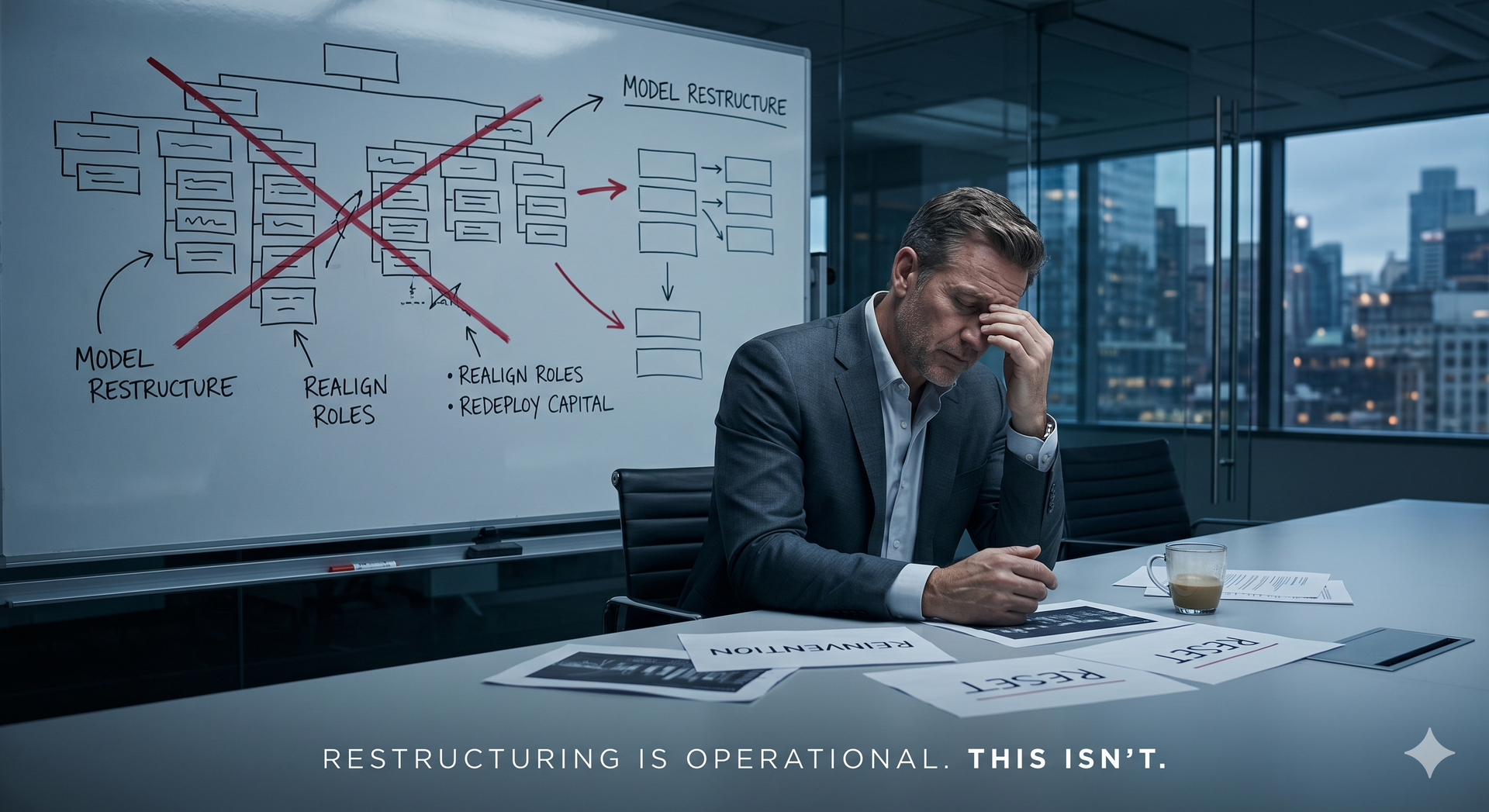
Learn how spiritual direction helps leaders manage grief & navigate change. Seek support for your organizational restructuring today.