Silent
Silent provides the tools for seekers to recognize their path and enables self-reliance for spiritual and magickal growth.
Seekers gain insight from his work and find their inner calm from his ability to listen and help others reflect.

Tone at the Top | For clinicians, regulators, and practitioners
There is an uncomfortable truth circulating quietly through conference halls, investor decks, clinics, and regulatory briefings alike: the psychedelic field is moving faster than the human systems that support it. Everyone feels it. Few are naming it plainly.
This is not an argument against growth. Nor is it nostalgia for a pre-commercial past that never truly existed. Psychedelic substances have always lived at the intersection of healing, power, culture, and economy. What has changed is the velocity and the incentives driving it.
Today’s growth curve rewards speed, branding, and market capture far more than clinical depth, ethical maturity, or long-term integration. That imbalance is no longer theoretical. It is structural. And it is beginning to show.
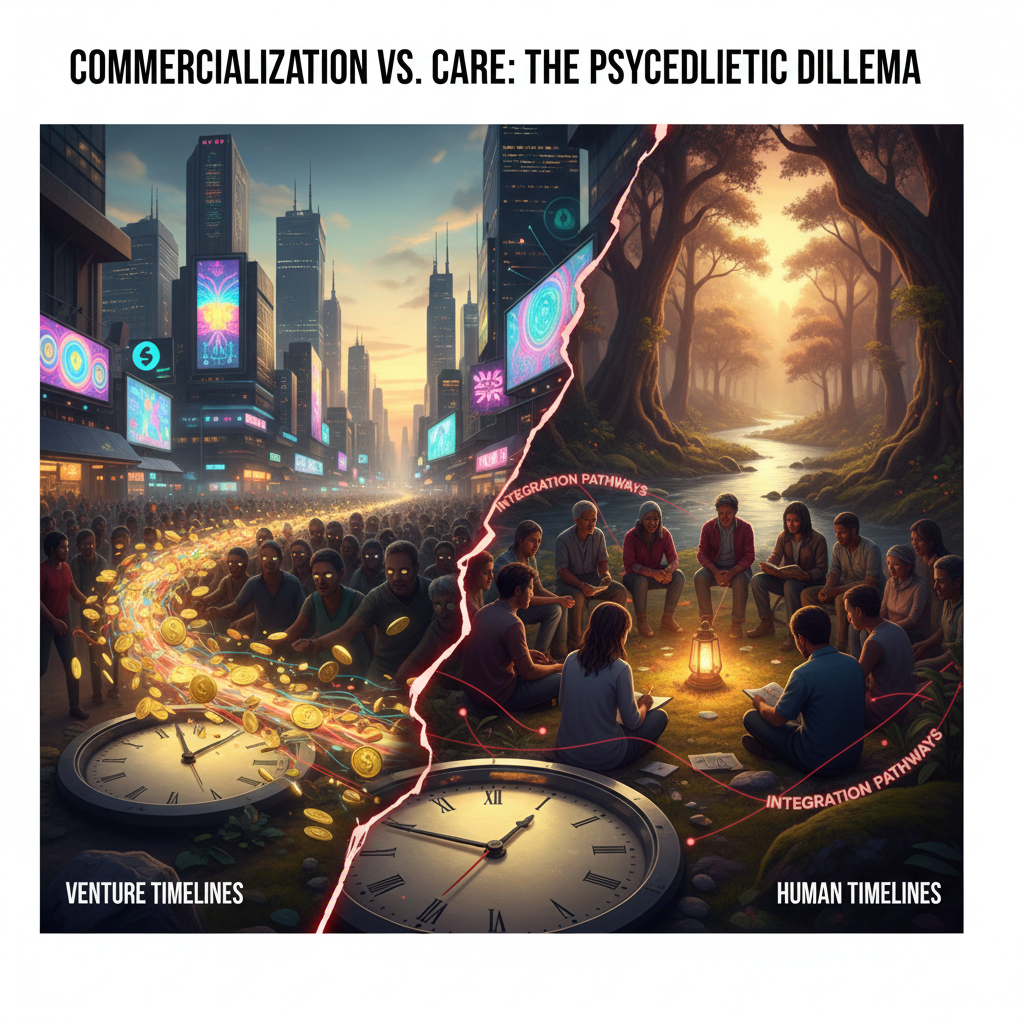
Venture Timelines vs. Human Integration Timelines
Capital moves on quarters. Humans do not.
Venture-backed timelines demand proof points: indications approved, clinics opened, patient throughput increased, IP secured. These pressures shape everything downstream, from trial design to therapist training to how outcomes are defined.
But psychedelic care unfolds on a different clock. Integration is nonlinear. Adverse experiences may surface months later. Meaning-making does not obey revenue models. A treatment that “works” at week six may unravel at month six if the container is thin.
Clinicians see this tension daily. Practitioners feel it in their bodies. Regulators sense it in the growing gap between protocol compliance and lived reality. When financial timelines compress human processes, the risk is not inefficiency; it is harm that arrives quietly, after the dashboards are green.
Brand Narratives Masking Structural Weakness
In a crowded market, story becomes currency.
Words like healing, transformation, and revolution now appear more frequently in pitch decks than in clinical supervision. The aesthetic of care, soft lighting, indigenous symbolism, carefully curated language, can give the impression of depth without the burden of building it.
Brand narratives can temporarily substitute for infrastructure. They can smooth over under-trained facilitators, thin integration pathways, or governance models that treat ethics as an appendix rather than a spine.
This is not cynicism; it is pattern recognition. When narrative runs ahead of operational maturity, organizations borrow trust instead of earning it. Borrowed trust always comes due.
The Monetization of Mystique
Psychedelics carry something rare in modern medicine: mystery.
That mystery is not a flaw, it is part of their power. But mystery, once monetized, becomes fragile. The field now sells access not only to molecules, but to meaning itself. Retreats promise insight. Clinics promise rebirth. Platforms promise scalability of the ineffable.
When mystique becomes a revenue driver, two distortions emerge. First, expectations inflate beyond what any ethical clinician would guarantee. Second, adverse outcomes are reframed as user failure rather than system responsibility.
This dynamic quietly erodes informed consent. Patients are no longer entering treatment; they are entering a narrative they feel pressured to fulfill.
What Happens When Trust Collapses
Trust is the invisible substrate of this entire ecosystem.
Patients extend trust not just to clinicians, but to institutions, regulators, and the unspoken promise that someone has thought deeply about second- and third-order effects. When trust collapses, it does not do so symmetrically.
Patients withdraw first. Then clinicians disengage. Regulators respond last, but decisively. History offers no shortage of examples where promising therapeutic modalities were set back decades, not because they failed clinically, but because they failed ethically under pressure.
A single high-profile breach, poor screening, inadequate integration, conflicts of interest obscured by branding, can reset the entire regulatory climate. Trust, once broken, is not rebuilt by marketing. It is rebuilt by restraint.
The Leadership Question No One Can Avoid
This is not a frontline problem. It is a leadership problem.
Boards, executives, principal investigators, and policy architects are shaping incentive structures right now that will determine whether this field matures, or fractures. The question is not can we grow? The question is what kind of growth are we legitimizing?
True leadership in this space requires resisting false binaries. It is possible to be commercially viable and clinically rigorous. It is possible to scale and still protect the slow, human work of integration. But it requires governance models that value delay as much as delivery.
It requires metrics that track downstream well-being, not just upstream access. It requires saying “not yet” when the market is shouting “now.”
Call to Action: Slow Growth Is Not Failure
Let us be precise.
For clinicians: protect your boundaries even when demand surges.
For practitioners: name when the container is thinning.
For regulators: resist pressure to equate speed with progress.
For leaders: build systems worthy of the states you are unleashing.
This field does not need more momentum. It needs more maturity.
The real question is not whether psychedelics will change medicine. They already have. The question is whether the industry built around them will earn the right to last.
ABOUT THE AUTHOR

Silent
Silent provides the tools for seekers to recognize their path and enables self-reliance for spiritual and magickal growth.
Seekers gain insight from his work and find their inner calm from his ability to listen and help others reflect.