Silent
Silent provides the tools for seekers to recognize their path and enables self-reliance for spiritual and magickal growth.
Seekers gain insight from his work and find their inner calm from his ability to listen and help others reflect.

A client once said something that still tightens my chest when I remember it:
“I signed the consent form. I even wanted it. But once I was in it… I would have agreed to anything.”
That sentence is the whole problem.
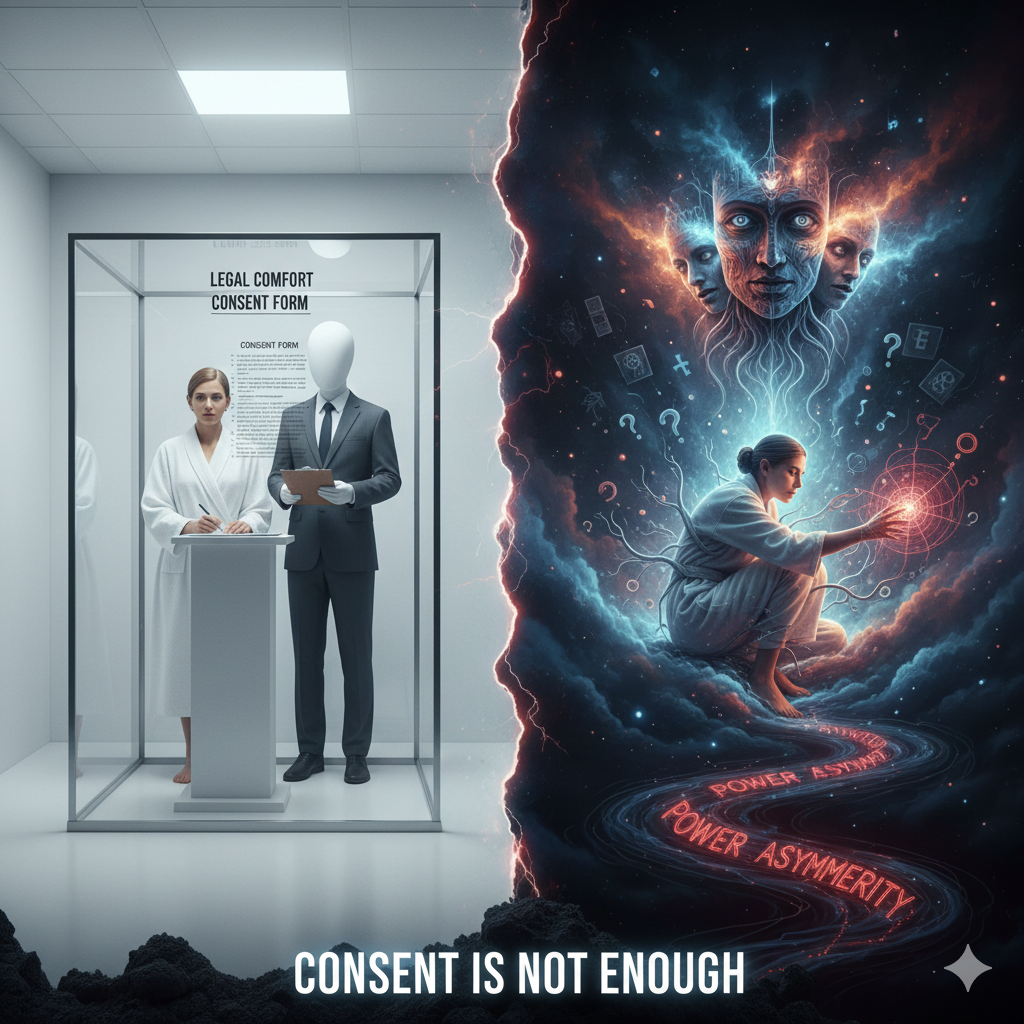
We like consent because it feels clean. It gives us paperwork, language, a signature. It lets facilitators and institutions say, We did our part. But in altered states—psychedelic, trance, breathwork, deep somatic release, intensive prayer, even certain hypnotic or charismatic group settings—traditional consent models start to fail right where we most need them.
Not because consent doesn’t matter. Because consent alone is not designed for asymmetry.
When consciousness shifts, power shifts. Suggestibility changes. Attachment patterns surge. The nervous system becomes porous. The meaning-making engine gets hot. And in that heat, “yes” can become less a choice and more an adaptation.
If we’re serious about integrity in this work, we have to stop designing consent for legal comfort—and start designing it for altered consciousness.
The limits of pre-session consent
Pre-session consent assumes a stable decision-maker.
It assumes a person can accurately forecast what it will feel like to be in a destabilized, emotionally amplified, reality-rewriting interior landscape. It assumes the “self” who signs the form is the same “self” who will be experiencing the session.
But altered states don’t work that way.
In the hours—or minutes—when someone is opening, grieving, dissociating, regressing, seeing symbols, meeting the dead, revisiting trauma, or merging with something they experience as divine, their capacity to evaluate risk and advocate for boundaries can radically diminish.
Not because they’re “weak.” Because they’re human.
Even in ordinary life, consent is contextual: the same touch can be welcome on one day and violating on another. In altered states, context doesn’t just change. It mutates. And the body’s “yes/no” signals can become harder to access, harder to name, harder to trust.
A signed form can’t anticipate:
· The sudden emergence of terror that wasn’t present in intake
· The impulse to please the guide when the psyche feels childlike
· The collapse of time, memory, or language
· The “sacred framing” that makes ordinary boundaries feel irrelevant
· The fear of being abandoned if the client says no mid-stream
So yes, get informed consent. Absolutely. But don’t mistake a pre-session “yes” for ongoing consent during a state where autonomy is fluid.
Consent must be dynamic, not static—designed to survive shifting inner weather.
Transference, authority, and suggestion
Altered states intensify transference. That’s not a theory; it’s a predictable human pattern.
In many journeys, a facilitator becomes more than a person. They become:
· A parent
· A rescuer
· A beloved
· A judge
· A priest
· A shaman
· The voice of God
· The one who “knows what’s happening”
Sometimes the client explicitly says this. More often, their nervous system behaves as if it’s true.
This is where power asymmetry becomes dangerous—not because the guide is malicious, but because the guide may be unaware how much authority the client is handing them.
Suggestion operates differently in altered consciousness. A lightly spoken sentence—“Stay with me.” “Trust this.” “You need to surrender.”—can land as doctrine. A hand on the shoulder can feel like salvation. A boundary crossing can be reframed as spiritual initiation.
And when someone is in the tenderness of transference, their “yes” can be an attempt to secure safety, closeness, or approval.
That means the ethical question changes.
It’s not only: Did the client consent?
It becomes: What conditions made that consent possible—and what conditions made it impossible?
If you hold the frame, you hold the power. If you hold the power, you must assume your influence is larger than you think it is.
Ethical containment vs. spiritual authority
One of the most common ways consent gets undermined in these spaces is through spiritual framing.
When a facilitator is positioned as a conduit—of medicine, spirit, lineage, God, higher intelligence—the client can feel that disagreement equals failure, or that saying no equals resisting their healing.
This is the difference between containment and authority.
Ethical containment says:
· “You are the ultimate authority on your body.”
· “We can pause. We can stop.”
· “Your ‘no’ is sacred.”
· “We’re not here to force transformation.”
· “We will go at your pace.”
Spiritual authority (even when unintentionally performed) says:
· “This is what the medicine wants.”
· “Your resistance is the problem.”
· “You have to surrender.”
· “This is your initiation.”
· “Trust me.”
Notice how quickly those phrases can dissolve agency.
Containment protects the person. Authority protects the story.
In altered states, stories are intoxicating. Clients want meaning. Facilitators want coherence. Communities want testimonies. And the temptation is to treat intensity as evidence of truth.
But intensity is not consent. Tears are not consent. Ecstasy is not consent. Awe is not consent.
The ethical posture is restraint: not using the state to get what you want—emotionally, sexually, financially, spiritually, reputationally. Not letting the client’s openness become your entitlement.
If you’re a guide, the goal is not to be believed. The goal is to be safe.
Institutional duty of care
The next layer is the one people avoid because it’s inconvenient:
This isn’t just a personal ethics issue. It’s an institutional one.
If an organization is hosting ceremonies, offering retreats, training facilitators, employing clinicians, or operating in any context where altered states occur, it carries a duty of care.
Duty of care means you don’t rely on charisma and good intentions. You build systems that assume risk is real.
That includes:
· Clear scope and role definition (therapy vs. coaching vs. clergy vs. guide)
· Explicit boundaries on touch, sexuality, finances, and dual relationships
· Ongoing consent protocols with mid-session check-ins and opt-out pathways
· Independent reporting channels (not “tell the lead facilitator who is the problem”)
· Supervision and consultation for facilitators working with transference
· Aftercare structures that don’t depend on continued access to the same guide
· Documentation practices that protect clients, not just institutions
· Cultural humility and trauma-informed training that goes beyond buzzwords
If a community says it’s healing people but has no meaningful complaint process, no supervision, no boundaries, and no accountability, it is not a healing community. It is a stage.
Altered states magnify whatever is already in the room. A healthy container becomes more healing. A porous container becomes more dangerous.
Call to action: Design consent for altered consciousness, not legal comfort
The easy move is to tighten language on forms and call it done.
The ethical move is to redesign the whole consent architecture.
Here’s the guiding principle:
Consent in altered states must be redundant.
Not because clients are incapable, but because conditions are unstable.
Redundant consent means:
· Consent is informed (what might happen, not only what you hope will happen)
· Consent is ongoing (check-ins, pause options, re-choosing)
· Consent is revocable without penalty (no shame, no spiritual diagnosis)
· Consent is protected by structure (rules that do not depend on mood or chemistry)
· Consent is backed by accountability (someone besides the facilitator can intervene)
Design for the moment when someone cannot speak. Design for the moment when they want to please you. Design for the moment when they think you’re God. Design for the moment when they’re terrified you’ll leave.
Do that, and you’ll stop asking, “Did they sign?”
You’ll start asking the better question:
Was their agency protected when it mattered most?
If you’re a facilitator, audit your language. Audit your touch policies. Audit your training. Audit your supervision. If you’re an institution, build real duty-of-care systems. If you’re a participant, trust the part of you that goes quiet when the frame feels unsafe.
Consent isn’t the finish line.
In asymmetric power dynamics—especially in altered states—consent is the beginning of responsibility.
ABOUT THE AUTHOR

Silent
Silent provides the tools for seekers to recognize their path and enables self-reliance for spiritual and magickal growth.
Seekers gain insight from his work and find their inner calm from his ability to listen and help others reflect.