Silent
Silent provides the tools for seekers to recognize their path and enables self-reliance for spiritual and magickal growth.
Seekers gain insight from his work and find their inner calm from his ability to listen and help others reflect.

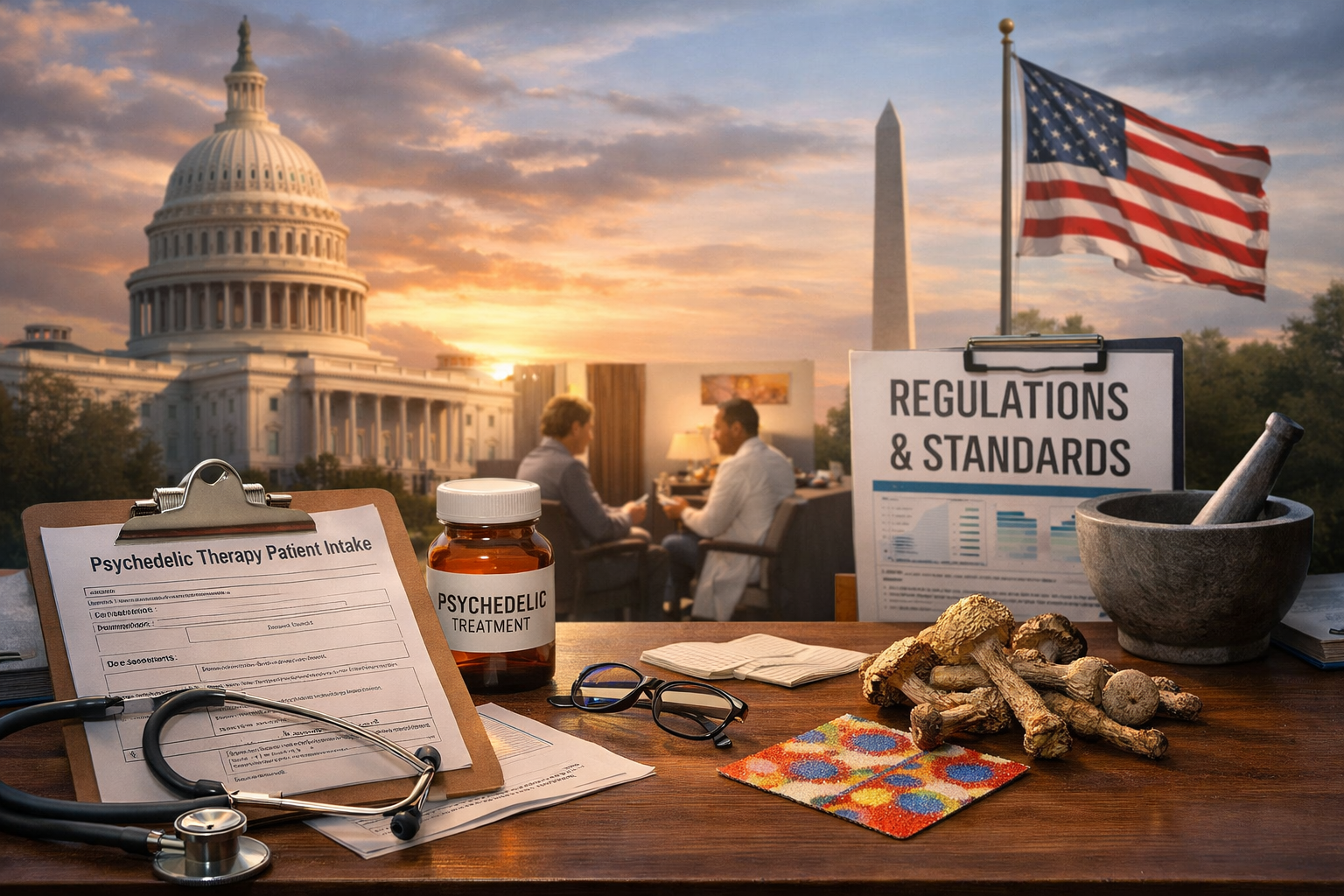
Thesis: Washington is signaling the pivot—medicalized access over retail models—and by 2026, that cultural decision will be cemented.
There’s a familiar temptation every time a new market opens: copy what worked last time. In psychedelics, that temptation wears the face of “storefront access”—bright signage, simplified narratives, and a promise that normalization equals scale. Washington’s task force moment quietly rejects that premise. Not with slogans. With structure.
What’s emerging is not hesitation; it’s intent. A deliberate move away from retail mimicry and toward clinical accountability. If you’re reading the signals correctly, 2026 won’t look like cannabis retail redux. It will look slower, narrower, and more professional by design.
The Allure of Storefront Psychedelics—and Why It’s Misleading
Retail feels intuitive. It’s visible, scalable, and familiar to regulators who lived through cannabis. But psychedelics are not a consumer packaged good with a stigma problem. They are powerful, non-linear interventions that interact with mental health, trauma, and meaning-making. That distinction matters.
The storefront model optimizes for access and throughput. Psychedelic-assisted modalities optimize for context, screening, preparation, and integration. Those priorities are fundamentally at odds.
Washington’s posture suggests lawmakers understand this tension. The conversation is less about where access happens and more about who is accountable when something goes wrong. Retail dissolves responsibility across brands and buyers. Clinical models concentrate it—on licensed professionals, documented protocols, and auditable outcomes.
This is not moralizing. It’s risk math.
Risk Management Is Compassion, Not Caution Theater
Speed is often framed as progress. In healthcare-adjacent domains, speed without guardrails is negligence wearing optimism.
Washington’s emphasis on professional standards—training requirements, supervision models, ethical frameworks—is being misread by some as bureaucratic drag. In reality, it’s a recognition that “slow” can be compassionate. It gives systems time to learn. It gives practitioners time to mature. It gives participants protection when expectations collide with reality.
Clinical accountability doesn’t eliminate harm, but it localizes responsibility. That’s the difference between a bad experience being a personal misfortune and a system failure that can be studied, corrected, and prevented.
By choosing standards over slogans, Washington is signaling that the real product here isn’t access—it’s trust.
2026 Predictions: What Will Keep Tightening (Without Saying “Legal”)
By 2026, expect less debate about whether psychedelics belong in regulated frameworks and more precision around how they are governed. Several trends are already visible:
• Credentialing will narrow, not widen. Facilitator roles will increasingly resemble allied health professions, with continuing education and peer review baked in.
• Data expectations will rise. Outcomes tracking, adverse event reporting, and longitudinal follow-up will move from “nice to have” to mandatory.
• Insurance and liability pressure will shape design. Even outside traditional reimbursement, malpractice frameworks will quietly dictate who can operate and how.
• Language will professionalize. Marketing-style narratives will give way to clinical terminology, consent rigor, and clearly bounded claims.
• Integration will be non-optional. Preparation and post-session support won’t be ancillary services; they’ll be structural requirements.
None of this requires federal legalization to become real. It requires regulators deciding what kind of harm they are—and are not—willing to absorb. Washington appears to be deciding now.
This Isn’t Cannabis. Stop Copying That Playbook.
Cannabis succeeded by normalizing consumption. Psychedelics will succeed by normalizing responsibility.
Cannabis retail taught us how fast markets can scale when the primary risk is misuse. Psychedelics confront a different category of risk: psychological destabilization, boundary violations, and meaning collapse. Those risks don’t belong in a checkout line.
Leadership, in moments like this, is about resisting false analogies. The safest path forward isn’t the loudest or the fastest. It’s the one that survives scrutiny five years from now.
Washington’s task force moment is not a pause. It’s a fork in the road.
Choose standards, and you get durability. Choose slogans, and you get headlines—followed by retrenchment.
Call to Action:
Ask your representative for standards, not slogans.
ABOUT THE AUTHOR

Silent
Silent provides the tools for seekers to recognize their path and enables self-reliance for spiritual and magickal growth.
Seekers gain insight from his work and find their inner calm from his ability to listen and help others reflect.