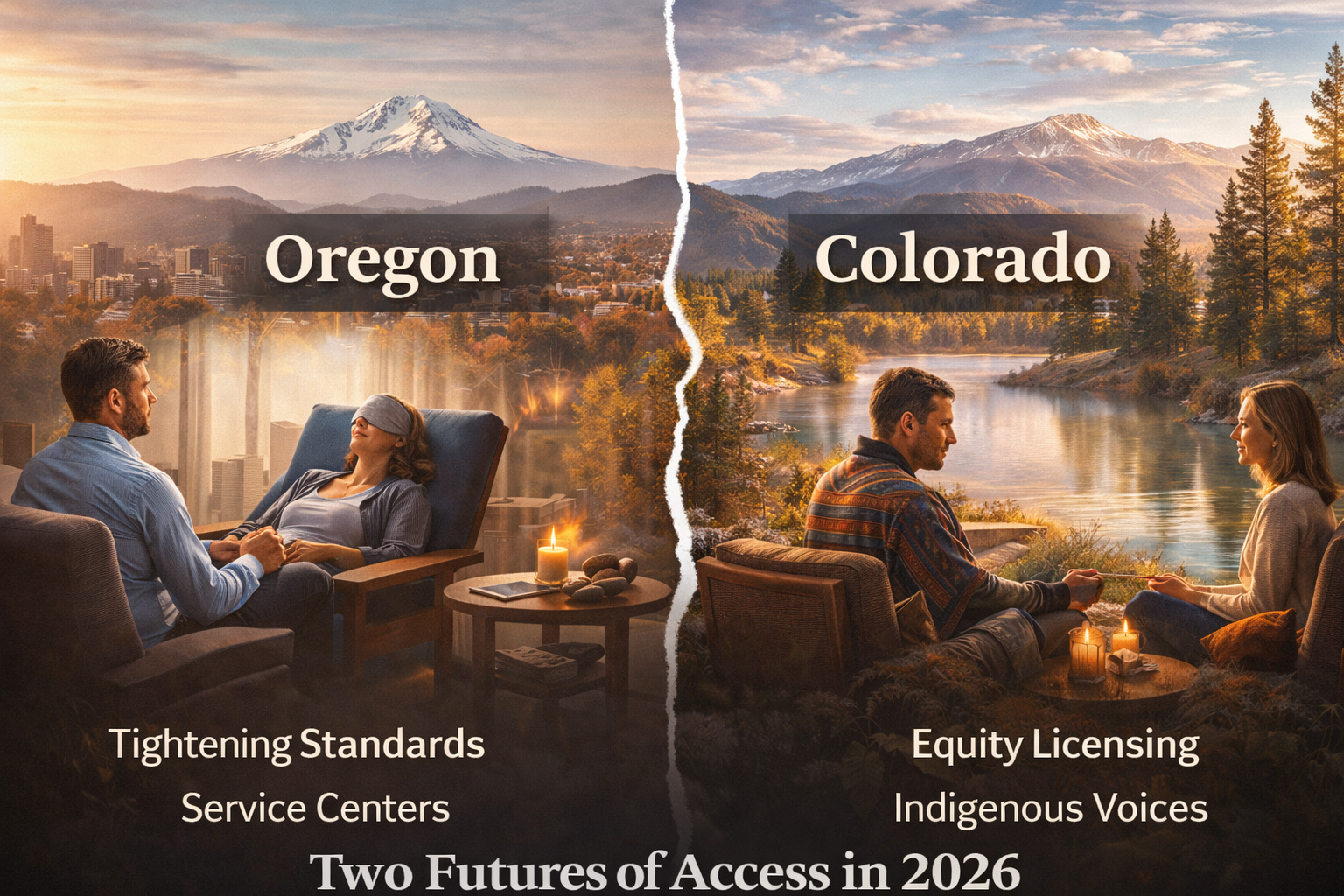
Oregon, Colorado, and the Two Futures of Access in 2026
Silent • January 7, 2026

Thesis: Oregon refined service centers. Colorado designed healing centers.
2026 will reveal which model actually scales
with integrity.


Top of Mind
Policy debates often end too early.

A bill passes. A framework launches. Headlines move on. But leaders know the truth: implementation is where intent is either honored—or quietly betrayed.

As we head into 2026, two states offer a live case study in how access evolves after legalization energy fades. Oregon and Colorado are no longer asking whether access exists. They are confronting a harder question: What kind of access survives contact with reality?

Their answers are diverging—and instructive.


What Oregon taught us about operations

Oregon’s early days were messy by design. The state moved fast, prioritized openness, and let the system reveal its own weak points. That phase is over.

What’s emerged is an operationally disciplined model centered on service centers, and the refinements are telling.

Training standards are tightening.
Initial facilitator requirements left too much to interpretation. In response, Oregon has begun clarifying competencies—not just hours logged, but demonstrated skills in preparation, holding altered states, and post-session integration. This isn’t about credential inflation; it’s about reducing variance where vulnerability is high.

Screening is no longer optional.
Early narratives romanticized accessibility. Experience corrected that. Medical history, psychological readiness, medication interactions, and support systems are now treated as foundational—not barriers, but safeguards. Oregon learned the hard way that access without screening creates downstream harm that no amount of integration can fully repair.

Integration is becoming non-negotiable.
Perhaps the most important shift: integration is no longer framed as “nice to have.” Service centers are increasingly required to demonstrate how insights are supported over time—through structured sessions, referrals, and continuity of care. Oregon’s model is converging on a simple truth executives recognize immediately:
outcomes decay without follow-through.

Operationally, Oregon has become quieter, slower, and more serious. That’s not a retreat. It’s maturation.


What Colorado emphasized from the start

Colorado took a different path—not faster, but broader. Where Oregon optimized delivery, Colorado focused on designing the ecosystem itself.

Equity licensing is structural, not symbolic.
Colorado embedded equity considerations directly into licensing frameworks, aiming to prevent early capture by well-capitalized operators. This wasn’t perfect, but it sent a clear signal: access is not just about who receives services, but who is allowed to provide them.

Indigenous consultation shaped the model.
Rather than treating Indigenous voices as ceremonial, Colorado engaged them as stakeholders in governance conversations. That didn’t resolve every tension, but it shifted the tone. Healing was framed less as a transaction and more as a responsibility carried across generations.

Outcomes data was prioritized early.
Colorado placed emphasis on what gets measured—not just utilization, but impact. This includes safety events, participant-reported outcomes, and longer-term indicators of well-being. The state implicitly acknowledged a leadership axiom too often ignored:
what you don’t measure, you don’t really care about.

Colorado’s approach is less operationally tight today—but culturally and ethically ambitious.


The 2026 friction points no one can avoid

As both models collide with scale, three friction points are becoming unavoidable.

Affordability.
High-touch care is expensive. Training, screening, supervision, and integration all cost money. Without intervention, access risks drifting toward those who can already afford private alternatives. Both states face pressure to reconcile integrity with affordability—without diluting either.

Workforce capacity.
Facilitators, clinicians, supervisors, and integration specialists are finite. Scaling demand without burning out the workforce is not a regulatory issue; it’s a leadership one. Oregon’s tighter standards and Colorado’s broader inclusion both strain the same human bottleneck.

Rural access.
Urban centers benefit first. That’s predictable—and unacceptable if equity is more than rhetoric. Rural access challenges transportation, workforce distribution, and cultural relevance. Neither state has cracked this yet. 2026 will force the issue.

Cross-pollination: what each state should steal from the other

If leaders are paying attention, the answer isn’t choosing one model. It’s selective theft.

What Oregon should steal from Colorado:

·      Formal equity metrics tied to licensing outcomes

·      Required outcomes reporting beyond safety compliance

·      Ongoing Indigenous and community consultation baked into governance

What Colorado should steal from Oregon:

·      Clear, enforceable training standards

·      Mandatory screening protocols

·      Defined integration pathways with accountability

This isn’t ideological blending. It’s operational wisdom. Strong systems borrow shamelessly.


Closing: implementation is policy

By 2026, the debate won’t be about access on paper. It will be about lived experience.

Leaders should internalize this now: implementation is policy. Training standards shape safety. Screening determines who is harmed or helped. Integration defines whether insight becomes change or fades into memory.

Frameworks don’t fail loudly. They fail quietly—through inconsistency, burnout, and unmeasured outcomes.

Call to Action
If you’re working in this space—clinician, operator, regulator, or funder—tell us what you believe should be measured. Not vanity metrics. Outcomes that actually matter.

Because what we choose to measure in 2026 will decide which future of access we’re really building.

Onward.

ABOUT THE AUTHOR


Silent


Silent provides the tools for seekers to recognize their path and enables self-reliance for spiritual and magickal growth. 


Seekers gain insight from his work and find their inner calm from his ability to listen and help others reflect.

By Silent February 8, 2026
A client once said something that still tightens my chest when I remember it: “I signed the consent form. I even wanted it. But once I was in it… I would have agreed to anything.” That sentence is the whole problem. We like consent because it feels clean. It gives us paperwork, language, a signature. It lets facilitators and institutions say, We did our part. But in altered states—psychedelic, trance, breathwork, deep somatic release, intensive prayer, even certain hypnotic or charismatic group settings—traditional consent models start to fail right where we most need them. Not because consent doesn’t matter. Because consent alone is not designed for asymmetry. When consciousness shifts, power shifts. Suggestibility changes. Attachment patterns surge. The nervous system becomes porous. The meaning-making engine gets hot. And in that heat, “yes” can become less a choice and more an adaptation. If we’re serious about integrity in this work, we have to stop designing consent for legal comfort—and start designing it for altered consciousness. The limits of pre-session consent Pre-session consent assumes a stable decision-maker. It assumes a person can accurately forecast what it will feel like to be in a destabilized, emotionally amplified, reality-rewriting interior landscape. It assumes the “self” who signs the form is the same “self” who will be experiencing the session. But altered states don’t work that way. In the hours—or minutes—when someone is opening, grieving, dissociating, regressing, seeing symbols, meeting the dead, revisiting trauma, or merging with something they experience as divine, their capacity to evaluate risk and advocate for boundaries can radically diminish. Not because they’re “weak.” Because they’re human. Even in ordinary life, consent is contextual: the same touch can be welcome on one day and violating on another. In altered states, context doesn’t just change. It mutates. And the body’s “yes/no” signals can become harder to access, harder to name, harder to trust. A signed form can’t anticipate: · The sudden emergence of terror that wasn’t present in intake · The impulse to please the guide when the psyche feels childlike · The collapse of time, memory, or language · The “sacred framing” that makes ordinary boundaries feel irrelevant · The fear of being abandoned if the client says no mid-stream So yes, get informed consent. Absolutely. But don’t mistake a pre-session “yes” for ongoing consent during a state where autonomy is fluid. Consent must be dynamic, not static—designed to survive shifting inner weather. Transference, authority, and suggestion Altered states intensify transference. That’s not a theory; it’s a predictable human pattern. In many journeys, a facilitator becomes more than a person. They become: · A parent · A rescuer · A beloved · A judge · A priest · A shaman · The voice of God · The one who “knows what’s happening” Sometimes the client explicitly says this. More often, their nervous system behaves as if it’s true. This is where power asymmetry becomes dangerous—not because the guide is malicious, but because the guide may be unaware how much authority the client is handing them. Suggestion operates differently in altered consciousness. A lightly spoken sentence—“Stay with me.” “Trust this.” “You need to surrender.”—can land as doctrine. A hand on the shoulder can feel like salvation. A boundary crossing can be reframed as spiritual initiation. And when someone is in the tenderness of transference, their “yes” can be an attempt to secure safety, closeness, or approval. That means the ethical question changes. It’s not only: Did the client consent? It becomes: What conditions made that consent possible—and what conditions made it impossible? If you hold the frame, you hold the power. If you hold the power, you must assume your influence is larger than you think it is. Ethical containment vs. spiritual authority One of the most common ways consent gets undermined in these spaces is through spiritual framing. When a facilitator is positioned as a conduit—of medicine, spirit, lineage, God, higher intelligence—the client can feel that disagreement equals failure, or that saying no equals resisting their healing. This is the difference between containment and authority. Ethical containment says: · “You are the ultimate authority on your body.” · “We can pause. We can stop.” · “Your ‘no’ is sacred.” · “We’re not here to force transformation.” · “We will go at your pace.” Spiritual authority (even when unintentionally performed) says: · “This is what the medicine wants.” · “Your resistance is the problem.” · “You have to surrender.” · “This is your initiation.” · “Trust me.” Notice how quickly those phrases can dissolve agency. Containment protects the person. Authority protects the story. In altered states, stories are intoxicating. Clients want meaning. Facilitators want coherence. Communities want testimonies. And the temptation is to treat intensity as evidence of truth. But intensity is not consent. Tears are not consent. Ecstasy is not consent. Awe is not consent. The ethical posture is restraint: not using the state to get what you want—emotionally, sexually, financially, spiritually, reputationally. Not letting the client’s openness become your entitlement. If you’re a guide, the goal is not to be believed. The goal is to be safe. Institutional duty of care The next layer is the one people avoid because it’s inconvenient: This isn’t just a personal ethics issue. It’s an institutional one. If an organization is hosting ceremonies, offering retreats, training facilitators, employing clinicians, or operating in any context where altered states occur, it carries a duty of care. Duty of care means you don’t rely on charisma and good intentions. You build systems that assume risk is real. That includes: · Clear scope and role definition (therapy vs. coaching vs. clergy vs. guide) · Explicit boundaries on touch, sexuality, finances, and dual relationships · Ongoing consent protocols with mid-session check-ins and opt-out pathways · Independent reporting channels (not “tell the lead facilitator who is the problem”) · Supervision and consultation for facilitators working with transference · Aftercare structures that don’t depend on continued access to the same guide · Documentation practices that protect clients, not just institutions · Cultural humility and trauma-informed training that goes beyond buzzwords If a community says it’s healing people but has no meaningful complaint process, no supervision, no boundaries, and no accountability, it is not a healing community. It is a stage. Altered states magnify whatever is already in the room. A healthy container becomes more healing. A porous container becomes more dangerous. Call to action: Design consent for altered consciousness, not legal comfort The easy move is to tighten language on forms and call it done. The ethical move is to redesign the whole consent architecture. Here’s the guiding principle: Consent in altered states must be redundant. Not because clients are incapable, but because conditions are unstable. Redundant consent means: · Consent is informed (what might happen, not only what you hope will happen) · Consent is ongoing (check-ins, pause options, re-choosing) · Consent is revocable without penalty (no shame, no spiritual diagnosis) · Consent is protected by structure (rules that do not depend on mood or chemistry) · Consent is backed by accountability (someone besides the facilitator can intervene) Design for the moment when someone cannot speak. Design for the moment when they want to please you. Design for the moment when they think you’re God. Design for the moment when they’re terrified you’ll leave. Do that, and you’ll stop asking, “Did they sign?” You’ll start asking the better question: Was their agency protected when it mattered most? If you’re a facilitator, audit your language. Audit your touch policies. Audit your training. Audit your supervision. If you’re an institution, build real duty-of-care systems. If you’re a participant, trust the part of you that goes quiet when the frame feels unsafe. Consent isn’t the finish line. In asymmetric power dynamics—especially in altered states—consent is the beginning of responsibility.
By Silent February 4, 2026
Insurance Will Decide What Ethics Could Not Tone at the Top There is a quiet but decisive force shaping the future of psychedelic medicine, and it is not regulators, ethicists, or even clinicians. It is insurers. For the last decade, the psychedelic field has leaned heavily on ethics statements, professional manifestos, and aspirational codes of conduct. These were necessary. They were also insufficient. Ethics without enforcement are values without leverage. And leverage, in modern healthcare, comes from risk underwriting. Insurers do not care how inspired your mission statement is. They care whether your outcomes are defensible, your processes repeatable, and your exposure containable. Where the industry hesitated to self-regulate with rigor, insurers will now impose standards with mathematical indifference. They will not be gentle. 1. Outcome Accountability Is No Longer Optional The psychedelic sector has relied on narrative outcomes for too long. “Transformational experiences.” “Breakthrough healing.” “Deep personal insight.” These may resonate culturally, but they fail actuarially. Insurers price risk, not intention. Underwriting models are already shifting toward outcome accountability—measurable, longitudinal, and comparative. This does not mean every patient must improve. It means you must be able to demonstrate how improvement is defined, tracked, and contextualized against known risk factors. Expect questions like: · How do you define a successful outcome at 30, 90, and 180 days? · What percentage of patients show symptom regression? · How are adverse psychological responses documented and escalated? · What is your protocol when integration fails? If your answers rely on practitioner intuition rather than documented pathways, coverage will narrow—or disappear entirely. The uncomfortable truth: insurers are becoming the de facto outcomes review board. Not because they want to shape consciousness, but because unmeasured outcomes create unbounded liability. 2. Documentation and Reproducibility Will Be the New Gatekeepers Psychedelic practice has celebrated the uniqueness of each journey. Insurers will tolerate that only up to the point where uniqueness becomes non-reproducibility. From an underwriting perspective, variability without structure is indistinguishable from negligence. Documentation requirements are already tightening: · Session preparation protocols · In-session monitoring records · Post-session integration notes · Referral and escalation criteria · Informed consent specificity (especially around non-ordinary states) Reproducibility does not mean standardizing the experience. It means standardizing the safeguards. Insurers are asking a simple question: If two different clinicians follow your model, will they make materially similar decisions when something goes wrong? If the answer is no, premiums rise. If the answer remains no, exclusions appear. This is where many well-meaning clinics will stumble. They confuse practitioner freedom with operational ambiguity. Insurers will not. 3. Liability Exposure Scenarios Are Expanding—Not Shrinking Much of the industry’s risk modeling remains stuck on acute harm: bad trips, boundary violations, or improper dosing. Insurers are already looking further downstream. Consider the emerging liability scenarios: · A client makes a major life decision post-session and later alleges undue influence. · A pre-existing dissociative condition is exacerbated despite screening. · A client discontinues psychiatric medication without medical coordination. · Integration support is insufficient, leading to functional impairment months later. · A clinician deviates from protocol under perceived “intuitive necessity.” Each of these scenarios is survivable—if you can show that your system anticipated them. Liability does not hinge on whether harm occurred. It hinges on whether harm was foreseeable and whether reasonable safeguards were in place. This is where insurers become unforgiving. Not because they are hostile to psychedelic work, but because ambiguity is expensive. 4. Why Insurers Care More About Integration Than Ideology Here is the paradox the industry has not fully grasped: insurers are less concerned with the psychedelic session itself than with what happens after. Integration is where risk lives. From an insurer’s point of view, the altered state is time-bound. Integration is indefinite. It is where meaning-making intersects with behavior, relationships, employment, and identity. It is where claims emerge. This is why underwriters are increasingly focused on questions such as: · Who provides integration, and with what credentials? · How long does integration support last? · What happens when integration reveals trauma beyond scope? · How are clients transitioned back to primary care or mental health services? · What documentation exists to show continuity of care? Ideology—whether spiritual, therapeutic, or transformational—does not mitigate risk. Structure does. Insurers are effectively saying: Believe whatever you want. Just show us how you prevent people from unraveling afterward. This is not an attack on meaning. It is an insistence on containment. 5. The Strategic Miscalculation the Industry Is Making Many psychedelic organizations assume that insurance pressure will slow the field. The opposite is more likely. Insurance standards will separate scalable models from boutique practices. Those who prepare will gain access to broader markets, institutional partners, and eventually public trust. Those who resist will be confined to the margins, regardless of their ethical purity. This is not a moral judgment. It is a market reality. Healthcare systems expand through risk transfer. If risk cannot be priced, it cannot be scaled. If it cannot be scaled, it will remain niche. The industry’s mistake is framing insurance as an external imposition rather than an internal mirror. Insurers are simply quantifying what the field has been reluctant to formalize. 6. Call to Action Prepare for underwriting questions now, or answer to exclusions later. This means: · Auditing your outcome definitions · Formalizing integration pathways · Stress-testing your documentation · Clarifying scope-of-practice boundaries · Designing for reproducibility, not mystique Insurance will decide what ethics could not—not because ethics failed, but because ethics without infrastructure cannot carry risk. The future of psychedelic medicine will not be determined by who speaks most eloquently about transformation, but by who can demonstrate responsibility under pressure. Tone at the top matters. And right now, the tone is being set by underwriters.
By Silent January 21, 2026
Tone at the Top | For clinicians, regulators, and practitioners  There is an uncomfortable truth circulating quietly through conference halls, investor decks, clinics, and regulatory briefings alike: the psychedelic field is moving faster than the human systems that support it. Everyone feels it. Few are naming it plainly. This is not an argument against growth. Nor is it nostalgia for a pre-commercial past that never truly existed. Psychedelic substances have always lived at the intersection of healing, power, culture, and economy. What has changed is the velocity and the incentives driving it. Today’s growth curve rewards speed, branding, and market capture far more than clinical depth, ethical maturity, or long-term integration. That imbalance is no longer theoretical. It is structural. And it is beginning to show. Venture Timelines vs. Human Integration Timelines Capital moves on quarters. Humans do not. Venture-backed timelines demand proof points: indications approved, clinics opened, patient throughput increased, IP secured. These pressures shape everything downstream, from trial design to therapist training to how outcomes are defined. But psychedelic care unfolds on a different clock. Integration is nonlinear. Adverse experiences may surface months later. Meaning-making does not obey revenue models. A treatment that “works” at week six may unravel at month six if the container is thin. Clinicians see this tension daily. Practitioners feel it in their bodies. Regulators sense it in the growing gap between protocol compliance and lived reality. When financial timelines compress human processes, the risk is not inefficiency; it is harm that arrives quietly, after the dashboards are green. Brand Narratives Masking Structural Weakness In a crowded market, story becomes currency. Words like healing, transformation, and revolution now appear more frequently in pitch decks than in clinical supervision. The aesthetic of care, soft lighting, indigenous symbolism, carefully curated language, can give the impression of depth without the burden of building it. Brand narratives can temporarily substitute for infrastructure. They can smooth over under-trained facilitators, thin integration pathways, or governance models that treat ethics as an appendix rather than a spine. This is not cynicism; it is pattern recognition. When narrative runs ahead of operational maturity, organizations borrow trust instead of earning it. Borrowed trust always comes due. The Monetization of Mystique Psychedelics carry something rare in modern medicine: mystery. That mystery is not a flaw, it is part of their power. But mystery, once monetized, becomes fragile. The field now sells access not only to molecules, but to meaning itself. Retreats promise insight. Clinics promise rebirth. Platforms promise scalability of the ineffable. When mystique becomes a revenue driver, two distortions emerge. First, expectations inflate beyond what any ethical clinician would guarantee. Second, adverse outcomes are reframed as user failure rather than system responsibility. This dynamic quietly erodes informed consent. Patients are no longer entering treatment; they are entering a narrative they feel pressured to fulfill. What Happens When Trust Collapses Trust is the invisible substrate of this entire ecosystem. Patients extend trust not just to clinicians, but to institutions, regulators, and the unspoken promise that someone has thought deeply about second- and third-order effects. When trust collapses, it does not do so symmetrically. Patients withdraw first. Then clinicians disengage. Regulators respond last, but decisively. History offers no shortage of examples where promising therapeutic modalities were set back decades, not because they failed clinically, but because they failed ethically under pressure. A single high-profile breach, poor screening, inadequate integration, conflicts of interest obscured by branding, can reset the entire regulatory climate. Trust, once broken, is not rebuilt by marketing. It is rebuilt by restraint. The Leadership Question No One Can Avoid This is not a frontline problem. It is a leadership problem. Boards, executives, principal investigators, and policy architects are shaping incentive structures right now that will determine whether this field matures, or fractures. The question is not can we grow? The question is what kind of growth are we legitimizing? True leadership in this space requires resisting false binaries. It is possible to be commercially viable and clinically rigorous. It is possible to scale and still protect the slow, human work of integration. But it requires governance models that value delay as much as delivery. It requires metrics that track downstream well-being, not just upstream access. It requires saying “not yet” when the market is shouting “now.” Call to Action: Slow Growth Is Not Failure Let us be precise. Slow growth is not failure. Careful sequencing is not weakness. Ethical friction is not inefficiency. Unexamined growth, however, is a liability. For clinicians: protect your boundaries even when demand surges. For practitioners: name when the container is thinning. For regulators: resist pressure to equate speed with progress. For leaders: build systems worthy of the states you are unleashing. This field does not need more momentum. It needs more maturity. The real question is not whether psychedelics will change medicine. They already have. The question is whether the industry built around them will earn the right to last.
Show More