Silent
Silent provides the tools for seekers to recognize their path and enables self-reliance for spiritual and magickal growth.
Seekers gain insight from his work and find their inner calm from his ability to listen and help others reflect.

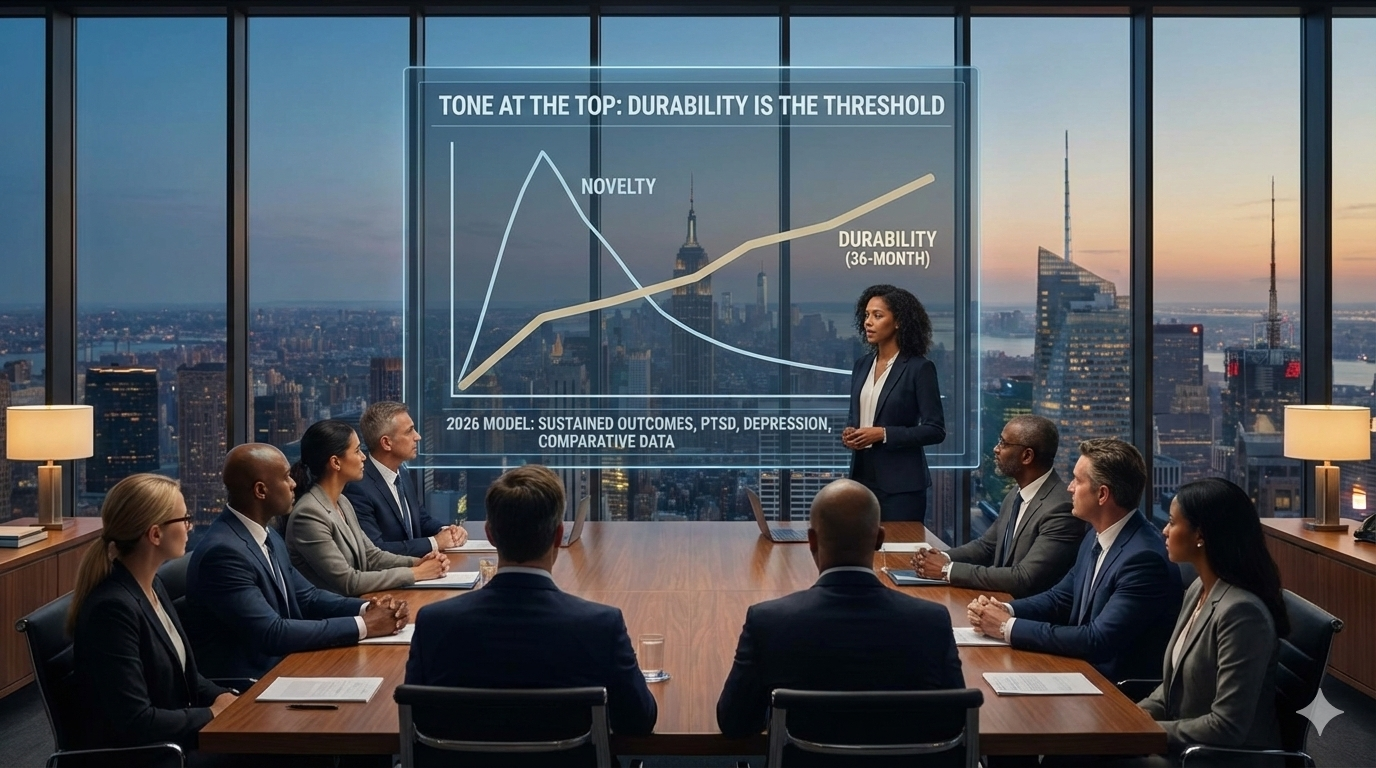
Welcome to Tone at the Top, where leadership meets evidence—and where hard questions are not an inconvenience, but a responsibility.
Over the last two years, 2025 in particular, we saw a welcome shift in research standards. The conversation moved beyond immediate outcomes and novelty effects toward durability—results measured not in days or weeks, but across 12 to 36 months. That was progress.
In 2026, durability is no longer a differentiator.
It is the
minimum bar for legitimacy.
If outcomes don’t persist, integrate, and hold under real-world conditions, then—no matter how compelling the early data—it didn’t happen.
Why “Wow” Results No Longer Count
Short-lived results once dazzled funders, media, and early adopters. Rapid symptom reduction. Immediate relief. The before-and-after graph looked like a miracle.
But leaders—whether in science, healthcare, or capital allocation—have learned this lesson the hard way:
What fades quickly costs more than what never worked at all.
Temporary relief creates false confidence.
False confidence leads to overreach.
Overreach erodes trust.
In 2026, we are no longer impressed by outcomes that peak early and decay quietly. The question is no longer “Does it work?” but “Does it last—and for whom?”
Durability is not a technical detail.
It is an ethical requirement.
The Research Tracks That Now Matter
As standards rise, so must the rigor of what we measure—and how long we measure it.
Three longitudinal tracks are now non-negotiable.
1. PTSD Durability
Short-term symptom reduction tells us very little. PTSD is not episodic; it is recursive. What matters is whether gains persist across triggers, life stressors, anniversaries, and identity reintegration.
If outcomes collapse at 9 or 18 months, the intervention has not resolved the condition—it has postponed it.
Durability here is measured not by symptom absence, but by functional resilience over time.
2. Depression and Anxiety: The Long Tail
The long tail is where truth lives.
Many interventions show early promise, followed by regression to baseline—or worse, a rebound effect. In 2026, research must account for relapse curves, secondary coping mechanisms, and identity coherence over multiple years.
A short-term mood lift without long-term stability is not success.
It is a
misleading proxy.
3. Comparative Outcomes vs. Existing Modalities
The bar is no longer novelty. The bar is
comparison.
Any new intervention must demonstrate not only efficacy, but comparative durability against established approaches—including ketamine-based protocols and SSRIs—across equivalent time horizons.
If outcomes are not measurably stronger, longer-lasting, or meaningfully different, the burden of proof has not been met.
Innovation that cannot outperform—or responsibly complement—existing standards is not progress. It is noise.
The Integration Variable No One Wants to Quantify
Here’s the inconvenient truth most studies still avoid:
Integration is the hidden independent variable.
Two participants can receive the same intervention and produce radically different outcomes—not because of dosage, protocol, or setting, but because of what happens after.
Integration determines:
· Whether insights become behavior
· Whether relief becomes resilience
· Whether meaning stabilizes or fractures
Yet integration is rarely standardized, measured, or resourced with the same rigor as the intervention itself.
That omission is no longer defensible.
In 2026, research that does not explicitly track integration quality—support structures, practices, follow-through, and community containment—is incomplete by design.
If we refuse to measure integration, we are not practicing scientific restraint.
We are practicing
convenient blindness.
Data Is Part of Humility
There is a deeper leadership lesson here.
Longitudinal data is not about control.
It is about humility.
It acknowledges that:
· Human systems are complex
· Change unfolds unevenly
· Early confidence is often misplaced
Demanding long-term evidence is not skepticism for its own sake. It is respect—for participants, practitioners, and the consequences of scale.
When leaders push for speed without durability, they are not being bold.
They are being impatient with reality.
In mature systems, patience is not passivity.
It is discipline.
The Responsibility of 2026
We are entering a phase where credibility will be earned not by enthusiasm, but by restraint. Not by promise, but by proof. Not by anecdotes, but by registries that tell the full story—including the uncomfortable parts.
This is not about slowing progress.
It is about ensuring progress
holds.
Call to Action
If you care about outcomes—not optics—support:
· Ethical, long-term research designs
· Transparent outcomes registries
· Integration models that are measured, not assumed
Because in 2026, durability is not a feature.
It is the threshold.
And data—real data, over time—is not a threat to belief.
It is how belief earns the right to exist.
Onward.
ABOUT THE AUTHOR

Silent
Silent provides the tools for seekers to recognize their path and enables self-reliance for spiritual and magickal growth.
Seekers gain insight from his work and find their inner calm from his ability to listen and help others reflect.