Silent
Silent provides the tools for seekers to recognize their path and enables self-reliance for spiritual and magickal growth.
Seekers gain insight from his work and find their inner calm from his ability to listen and help others reflect.

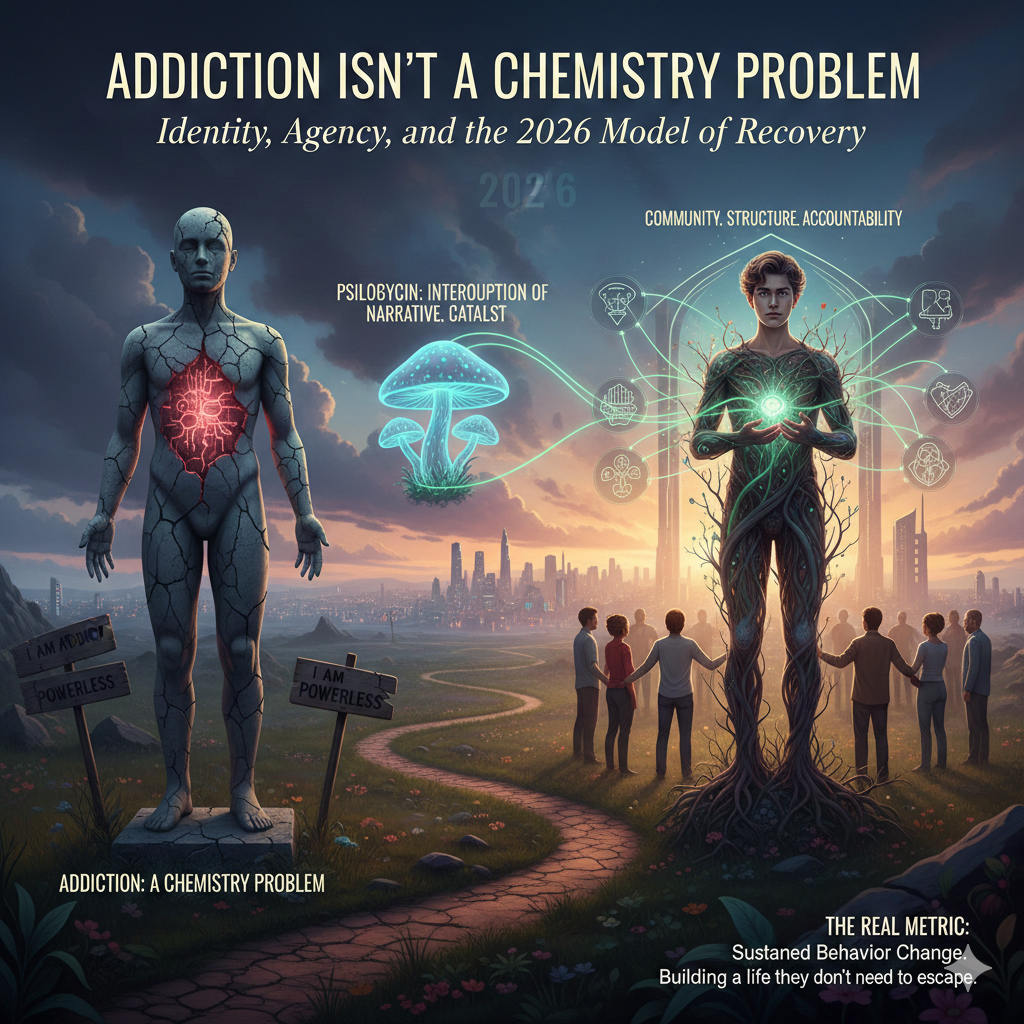
For decades, addiction has been framed primarily as a chemistry problem: receptors, dopamine loops, hijacked reward systems.
That framing produced real advances, but it also created a quiet distortion. It taught people to see themselves as broken machines rather than agents capable of change.
As we move into 2026, that model is cracking. Not because biology doesn’t matter, it does, but because chemistry alone cannot explain why some people recover and others remain trapped, even when cravings subside.
The emerging truth is uncomfortable and hopeful at the same time: addiction persists less because of craving and more because of identity.
When “I Am an Addict” Becomes a Cage
Identity-based recovery language has saved lives. It has also, for some, become a ceiling.
“I am an addict” can be grounding when chaos reigns. It can offer humility, solidarity, and a shared vocabulary for struggle. But over time, that same phrase can harden into a fixed self-concept, one that subtly removes agency.
If relapse is proof of who I am, rather than something I did, the future narrows. If my identity is permanently organized around pathology, growth becomes conditional. Agency is outsourced to abstinence rather than practiced as a skill.
This is not an argument against recovery communities. It’s an argument against confusing orientation with destiny.
People do not heal by rehearsing who they were at their worst. They heal by discovering who they can become, and then practicing that self consistently, especially when it’s uncomfortable.
What the Medicine Can Actually Do
Psilocybin is often described as “anti-craving.” That’s misleading.
The most durable effect of psilocybin in addiction work is not suppression of desire. It is interruption of narrative.
Under the right conditions, the medicine can loosen rigid identity stories:
· “I am powerless.”
· “I always fail.”
· “This is just how I’m wired.”
· “I can’t trust myself.”
In that opening, something more fragile, and more powerful, can appear: agency.
People report moments of values clarity: This matters. That doesn’t.
They experience self-trust not as bravado, but as quiet alignment.
They glimpse themselves acting differently, and believing it.
This is not magic. It’s perspective. A brief suspension of the internal narrator that says, You already know how this ends.
But here’s the part that gets ignored: that opening is temporary.
What the Medicine Cannot Do
Psilocybin cannot build a life.
It cannot create habits.
It cannot enforce boundaries.
It cannot show up on Tuesday night when loneliness hits.
It cannot repair relationships through repetition and humility.
Without structure, the insight collapses under daily pressure. Without community, agency erodes. Without accountability, clarity becomes memory.
This is where many modern approaches fail. They overvalue peak experience and undervalue containment. They treat insight as outcome rather than invitation.
A breakthrough without scaffolding doesn’t liberate, it destabilizes.
The 2026 Best Practice: Pairing Models, Not Replacing Them
The future of addiction recovery is not replacement. It’s integration.
By 2026, best practice will no longer ask, Which model is right?
It will ask, Which combination is sufficient?
Twelve-step programs offer community, ritual, and long-term accountability.
SMART Recovery emphasizes cognitive tools and self-efficacy.
Therapy addresses trauma, attachment, and nervous system regulation.
Peer recovery models normalize struggle without romanticizing it.
Psychedelic work, when done ethically, can act as a catalyst, but only if something is ready to catch the spark.
The mistake is positioning the medicine as the solution.
The opportunity is positioning it as an accelerant inside an already-built container.
Agency Is Practiced, Not Declared
One of the quiet shifts happening now is a reframing of responsibility.
Responsibility does not mean blame.
Agency does not mean white-knuckling.
Agency means practicing choice when choice feels boring, repetitive, and unrewarded. It means building trust with yourself through consistency, not intensity.
Recovery that lasts is not dramatic. It’s operational.
· Who do you call when you want to disappear?
· What structure exists between insight and action?
· What behavior changes are non-negotiable?
· Who is allowed to tell you the truth without being exiled?
These questions matter more than the content of any single experience.
The Real Metric Isn’t the Peak
The psychedelic space loves transformation stories. Recovery does not.
The real metric is sustained behavior change:
· Are relationships more honest six months later?
· Are boundaries being kept when no one is watching?
· Is agency being exercised under stress?
· Is the person building a life they don’t need to escape?
Peak experiences fade. Identity, reinforced through behavior, remains.
Build the Container First
Here is the uncomfortable truth we need to say out loud in 2026:
If you don’t have a recovery container, you’re not ready for the sacrament.
Not because the medicine is dangerous, but because it’s honest. It will show you what matters. It will not make you live it.
That part is still yours.
So build the container:
· Community before chemistry
· Structure before insight
· Accountability before transcendence
Then, if the opening comes, something real might take root.
Because addiction isn’t solved by interrupting craving.
It’s transformed when identity, agency, and behavior finally align.å
ABOUT THE AUTHOR

Silent
Silent provides the tools for seekers to recognize their path and enables self-reliance for spiritual and magickal growth.
Seekers gain insight from his work and find their inner calm from his ability to listen and help others reflect.