Integration Becomes a Discipline: Why the 2026 Standard Is Months, Not Minutes
Silent • December 31, 2025

Thesis: 2025 made integration essential. 2026 makes it structured.

For years, the psychedelic conversation has been dominated by the moment of experience, the ceremony, the medicine, the breakthrough. The story arc often peaks at insight and fades quickly into a single integration session, a journal prompt, or a casual check-in a week later.

That era is ending.

By 2025, most serious practitioners, facilitators, and clinicians acknowledged an uncomfortable truth: experience without integration doesn’t reliably create change. By 2026, the next truth becomes unavoidable, integration is not an event. It is a discipline.

And disciplines require structure, time, and accountability.


1.         Why One Follow-Up Session Fails Most People

The assumption behind the single integration session is seductive: If the insight was profound enough, it should carry itself.

But that assumption misunderstands how humans change.

Psychedelic experiences often generate state-based insight, clarity that emerges in a non-ordinary state of consciousness. When the nervous system returns to baseline, the insight competes with old habits, unresolved trauma, and unexamined belief systems. Without continued support, the system defaults to what it knows.

This is why people report:

·      “I know what I saw, but I can’t live it.”

·      “It felt true then, but now I’m confused.”

·      “Something opened, and now I feel raw, anxious, or ungrounded.”

The problem isn’t the medicine.
The problem is the
compression of integration into a moment that cannot carry the load.


2.        The Three Integration Tracks That Will Define 2026

By 2026, integration will no longer be treated as a generic conversation. It will be recognized as three distinct but interdependent tracks, each requiring its own literacy.

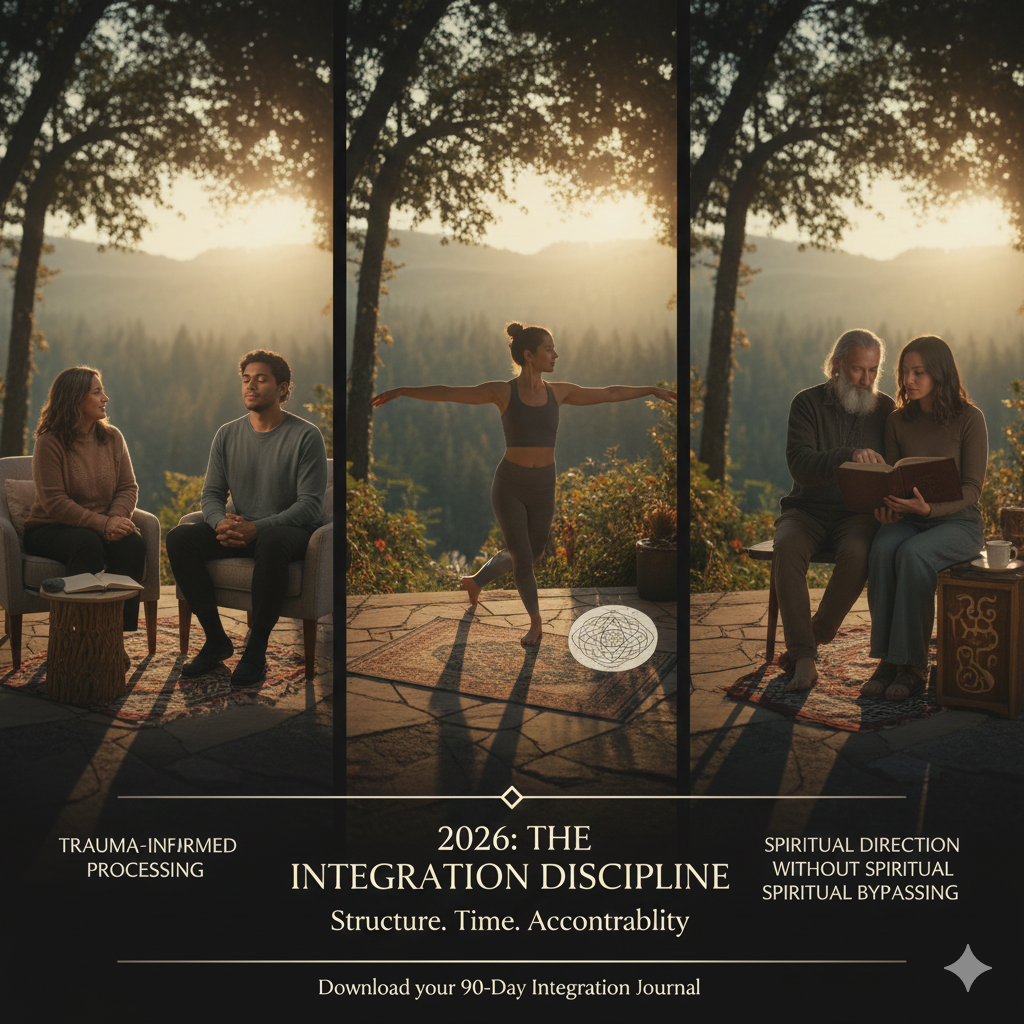
1. Trauma-Informed Processing

Insight often loosens material that predates language, attachment wounds, developmental trauma, stored fear. Without trauma literacy, facilitators unintentionally push meaning-making too fast.

Trauma-informed integration slows the work down. It prioritizes safety over interpretation and teaches people how to stay present with what emerged rather than explain it away.

2. Somatic Stabilization

The body always integrates first, or not at all.

Psychedelic experiences frequently disrupt autonomic regulation. People report insomnia, hypersensitivity, emotional flooding, or dissociation weeks later. Somatic stabilization restores rhythm to the nervous system through breath, movement, orienting practices, and pacing.

This isn’t optional. A dysregulated body cannot embody insight.

3. Spiritual Direction Without Spiritual Bypassing

Psychedelics reliably generate transpersonal and mystical experiences. What 2026 demands is spiritual maturity, not spiritual inflation.

Spiritual direction provides a container where meaning is explored without bypassing grief, responsibility, or psychological reality. The question shifts from “What did it mean?” to “How does this change how I live, relate, and choose?”


3.         A Practical Framework: The 90-Day Integration Arc

The emerging standard is not a single session, but a 90-day arc that mirrors how humans actually adapt.

Weeks 1–2: Containment and Orientation

The focus is grounding, not interpretation. Stabilizing sleep, diet, sensory input, and emotional range. Naming what happened without rushing to define it.

Primary question: Am I safe in my body and life right now?

Weeks 3–6: Meaning-Making and Pattern Recognition

Now the insight is examined in context, relationships, work, identity, behavior. Patterns are named. Choices are surfaced. Somatic practices continue alongside reflective work.

Primary question: What is asking to change, and what resists that change?

Weeks 7–12: Embodiment and Application

Insight becomes action. Boundaries are renegotiated. Habits are adjusted. Values are tested in real-world friction.

Primary question: How does this insight show up on an ordinary Tuesday?


4.        When Mystical Insight Isn’t Grounded

“Mystical insight without grounding can destabilize.”

In real life, this looks like:

·      Abrupt life decisions without preparation

·      Spiritual superiority masking avoidance

·      Heightened sensitivity without regulation

·      Identity confusion framed as “awakening”

This is not failure, it’s unfinished integration.

The work isn’t to suppress insight, but to anchor it, so it strengthens life rather than fragments it.


5.         Closing: Integration Is Where Outcomes Are Actually Made

The experience opens the door.
Integration decides what walks through it.

By 2026, the leaders in this space, clinicians, facilitators, retreat centers, and educators, will be defined not by how powerful the experience was, but by how well people are living six months later.

Integration is no longer support work.
It is the work.


Call to Action

To support this shift, we’re offering a free integration journal template and prompt set designed for a 90-day arc, bridging trauma awareness, somatic grounding, and spiritual reflection without bypassing.

Because the real transformation doesn’t happen in the ceremony.

It happens in the months that follow.

ABOUT THE AUTHOR


Silent


Silent provides the tools for seekers to recognize their path and enables self-reliance for spiritual and magickal growth. 


Seekers gain insight from his work and find their inner calm from his ability to listen and help others reflect.

By Silent January 1, 2026
The 2026 Conversation We Keep Avoiding
By Silent December 29, 2025
Neuroplasticity, Healing, and the Psychedelic “Window”
By Lawrence Lerner December 29, 2025
The year 2025 marked a consolidating phase in the psychedelic movement. Less spectacle, more infrastructure. Less rhetoric, more data. The field continued its transition from countercultural promise into regulated, clinically grounded practice—particularly around psilocybin as a treatment for trauma, PTSD, anxiety, and addiction. What distinguished 2025 was not a single sweeping legalization, but the maturation of state-by-state policy, expanded research access, clinician training, and integration frameworks that are now understood as essential rather than optional. Major U.S. State Initiatives (2025) Rather than re-litigating early decriminalization victories, 2025 focused on implementation . Oregon Continued rollout and refinement of licensed psilocybin service centers. 2025 saw tighter standards around facilitator training, screening protocols, and post-session integration requirements. Colorado Finalized regulatory frameworks for natural medicine healing centers. The state emphasized equity licensing, indigenous consultation, and data collection tied to outcomes rather than ideology. California While broad decriminalization stalled legislatively, pilot programs tied to veteran mental health, end-of-life distress, and university research quietly expanded under existing research exemptions. Washington Advanced psilocybin-assisted therapy task force recommendations, emphasizing medicalized access over retail-style models. Massachusetts & New York Focused on clinical trials and compassionate use pathways , particularly for treatment-resistant depression and trauma-related disorders. Texas Continued state-supported research into psychedelic-assisted therapies for veterans, with an emphasis on PTSD and moral injury rather than recreational framing. The pattern is clear: states are moving slowly, deliberately, and clinically , prioritizing risk management, data, and professional accountability. Summary of Overall Progress 2025 was a year of credibility building . Psychedelics are now discussed primarily as therapeutic tools , not cultural symbols. Regulatory bodies increasingly require integration plans , not just dosing protocols. Mental health professionals are involved earlier and more deeply in program design. Insurance and health systems began exploratory conversations—not coverage yet, but modeling. The movement matured by learning restraint. Major Research Studies & Institutions Several research streams continued or expanded in 2025, particularly through organizations such as Johns Hopkins Center for Psychedelic and Consciousness Research, MAPS, and leading university medical centers. Key areas of study included: Psilocybin-assisted therapy for treatment-resistant PTSD Long-term outcomes (12–36 months) for depression and anxiety Comparative studies between psilocybin, ketamine, and traditional SSRIs Neuroplasticity markers and default mode network modulation Group-based therapy models versus individual sessions Importantly, 2025 emphasized longitudinal data , addressing earlier critiques that psychedelic benefits were “impressive but short-lived.” The emerging picture suggests durability when—and only when—integration is done well. Clinical Use: Trauma, PTSD, Anxiety, Addiction By 2025, clinical consensus had sharpened around several observations: Trauma & PTSD Psilocybin does not erase trauma. It reduces avoidance , softens fear responses, and allows memory reconsolidation without overwhelming the nervous system. Clinicians consistently report increased emotional flexibility rather than cathartic release alone. Anxiety (including end-of-life anxiety) Benefits correlate strongly with meaning-making, not symptom suppression. Patients report reduced existential fear, increased acceptance, and restored relational capacity. Addiction Psilocybin is not an anti-craving drug. Its efficacy lies in disrupting rigid identity narratives (“I am an addict”) and restoring agency, values clarity, and self-trust—when paired with behavioral and community support. Across all indications, set, setting, and integration remain decisive variables. The Evolution of Integration Practices If earlier years were about access, 2025 was about integration becoming its own discipline . Key shifts: Integration is now understood as months-long , not a single follow-up session. Spiritual direction, somatic therapy, and trauma-informed care are increasingly blended. Journaling, ritual, community processing, and nature-based practices are formally encouraged. Clinicians recognize that mystical insight without grounding can destabilize rather than heal. In spiritual direction contexts, integration focuses on: Meaning rather than interpretation Embodiment rather than explanation Relationship repair rather than transcendence chasing Let me say this plainly: the medicine opens the door; integration teaches you how to live in the house . Closing Reflection 2025 did not bring a psychedelic revolution. It brought something more valuable: responsibility . Psilocybin is no longer treated as a miracle or a menace. It is being approached as a powerful, non-ordinary tool that requires humility, ethics, and disciplined care. The conversation has shifted from “Does it work?” to “For whom, under what conditions, and at what cost?” That is how real healing traditions are born. And that—quietly—is the most important progress of all. 
Show More