Silent
Silent provides the tools for seekers to recognize their path and enables self-reliance for spiritual and magickal growth.
Seekers gain insight from his work and find their inner calm from his ability to listen and help others reflect.

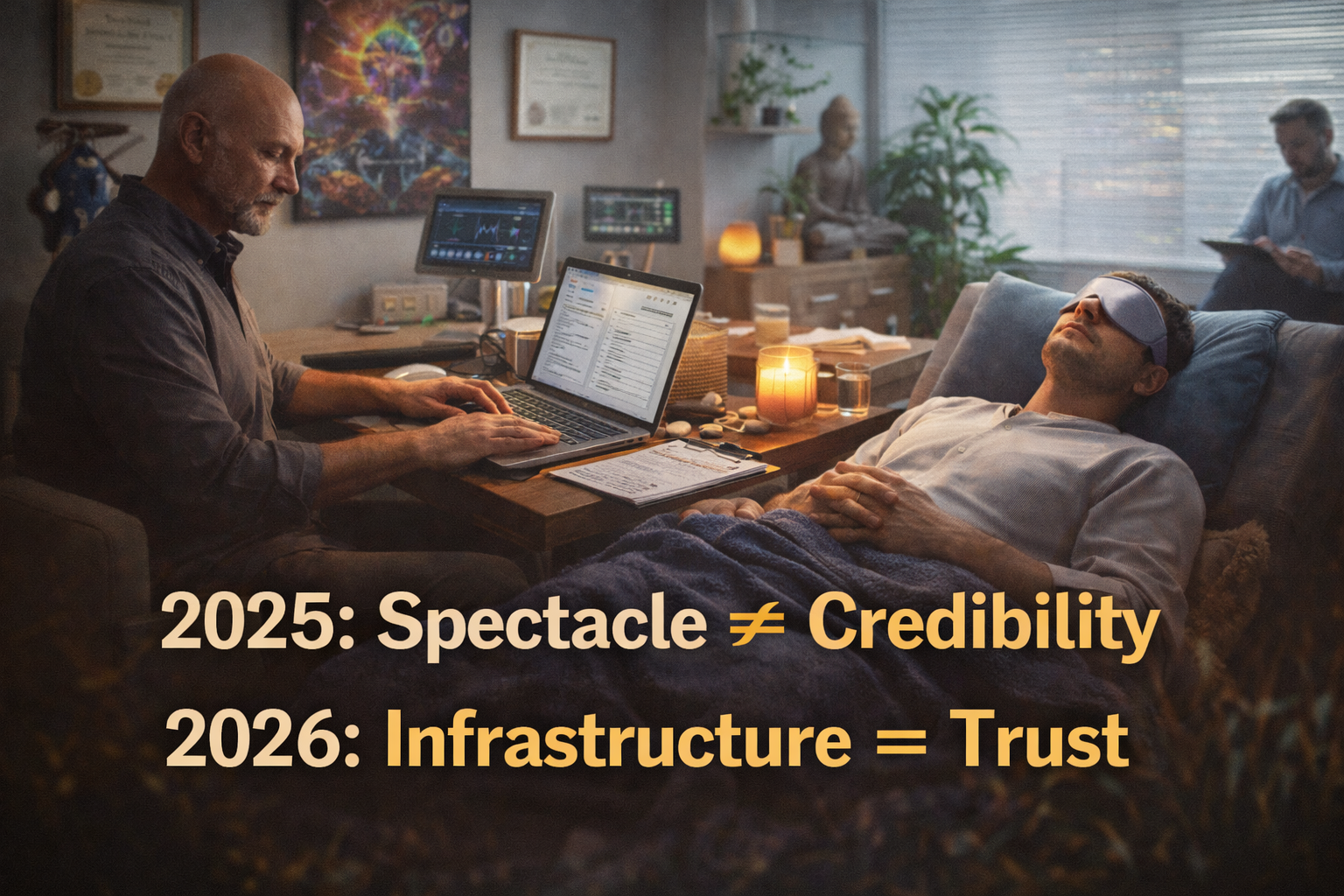
2025 was the year psychedelic care learned how to look credible.
Clinics polished their websites. Protocols got named. Decks got built. Conferences got louder. Everyone learned the right words: set and setting, trauma-informed, integration, safety. And for a while, that was enough. The movement needed legitimacy, and it earned some, through early data, cautious regulation, and a growing public willingness to admit that “mental health as usual” is not working.
Now comes the harder year.
2026 either builds systems or burns trust.
Because spectacle has a half-life. Infrastructure doesn’t.
“Less spectacle, more infrastructure” needs to become the baseline—not a slogan, not a branding mood, but the operating philosophy. The next era of psychedelic care won’t be won by charisma. It will be won by the boring parts.
TokeepSilent.
When I say infrastructure, I don’t mean “more clinics.” I mean the scaffolding that makes care reliable when nobody is watching.
2026 is the year screening stops being a marketing checkbox and becomes a clinical reflex.
Not “Are you anxious?” Not “Any heart issues?” I mean structured, documented screening that respects two truths at once:
Infrastructure is a clinic that knows the difference between an appropriate candidate and a high-risk situation and doesn’t let revenue blur that line. It’s a facilitator who can say, cleanly, “Not yet,” without shame or superiority. It’s also the ability to offer an alternative path: stabilization, therapy, skill-building, medical evaluation, then reassess.
If your model can’t withstand the word “no,” it isn’t care. It’s a sales funnel.
In 2025, a lot of programs operated like islands—well-intended, but isolated. In 2026, that becomes malpractice-adjacent.
Infrastructure means referral networks that actually function:
If your participant has a rough re-entry, who catches them? If your answer is “our integration circle,” you’re not ready. Circles are sacred. They are not a substitute for clinical continuity.
A mature program knows its lane, and it builds bridges to adjacent lanes.
This is where the industry either grows up or gets regulated into the ground.
In 2026, the question won’t be “Do you have testimonials?” The question will be: Can you show your work?
Infrastructure is:
And here’s the point that makes people squirm: outcomes tracking is not just for proving success. It’s for seeing where you are failing—quietly, repeatedly—before those failures become headlines.
Trust isn’t built by claiming you’re safe. Trust is built by behaving like safety is measurable.
Trust breaks in predictable ways. The same handful of cracks, over and over.
Overpromising.
If you talk like psychedelics are a cure, you will eventually harm someone who needed careful realism. Use adult language: possible benefit, non-linear healing, risks, and unknowns.
Blurry roles.
If the facilitator becomes therapist, clergy, best friend, and savior, harm follows. Boundaries are not cold. Boundaries are protective love.
Failure to triage.
When a participant shows signs of mania, psychosis risk, severe dissociation, active substance instability, or acute suicidality—your job is not courage. Your job is containment, referral, and stabilization.
Integration theatre.
A few journaling prompts and a group share is not integration. Integration is the slow weaving of insight into behavior: relationships, sleep, sobriety, trauma processing, meaning-making, accountability. It’s months, not minutes.
No plan for “when it goes sideways.”
Every credible program has a practiced plan: medical escalation, psychiatric escalation, emergency contacts, documentation, follow-up cadence, and a culture that does not hide incidents to protect the brand.
Prevention is simple to say, harder to live: treat this like healthcare, not like a movement.
The industry wants heroic stories: one session, a life transformed, the sky parting.
But 2026 belongs to a different virtue: restraint.
Restraint looks like longer prep. More consults. More collaboration. Fewer participants. More exclusions. Clearer dosing-day staffing ratios. More follow-ups. More referrals out.
Restraint is how you keep people alive, whole, and empowered.
In my world—spiritual direction, death work, trauma work—maturity always moves the same direction: away from performance, toward presence. The sacred isn’t rushed. And neither is the nervous system.
TokeepSilent.
If you’re running a clinic, facilitating, or seeking care in 2026, here’s your litmus test.
Clinics / programs
Facilitators
Seekers
And the call to action is blunt for a reason:
If you’re building a program in 2026, build the boring parts first.
ABOUT THE AUTHOR

Silent
Silent provides the tools for seekers to recognize their path and enables self-reliance for spiritual and magickal growth.
Seekers gain insight from his work and find their inner calm from his ability to listen and help others reflect.