Psychedelics Are a Systems Responsibility, Not a Personal Breakthrough Tool
Silent • January 20, 2026

There is a quiet but consequential mistake embedded in much of today’s psychedelic discourse: the belief that transformation is primarily an individual achievement.


A journey is framed as personal insight. Healing is treated as a private awakening. Integration is often reduced to self-reflection and journaling.


This framing is not just incomplete. It is unsafe.


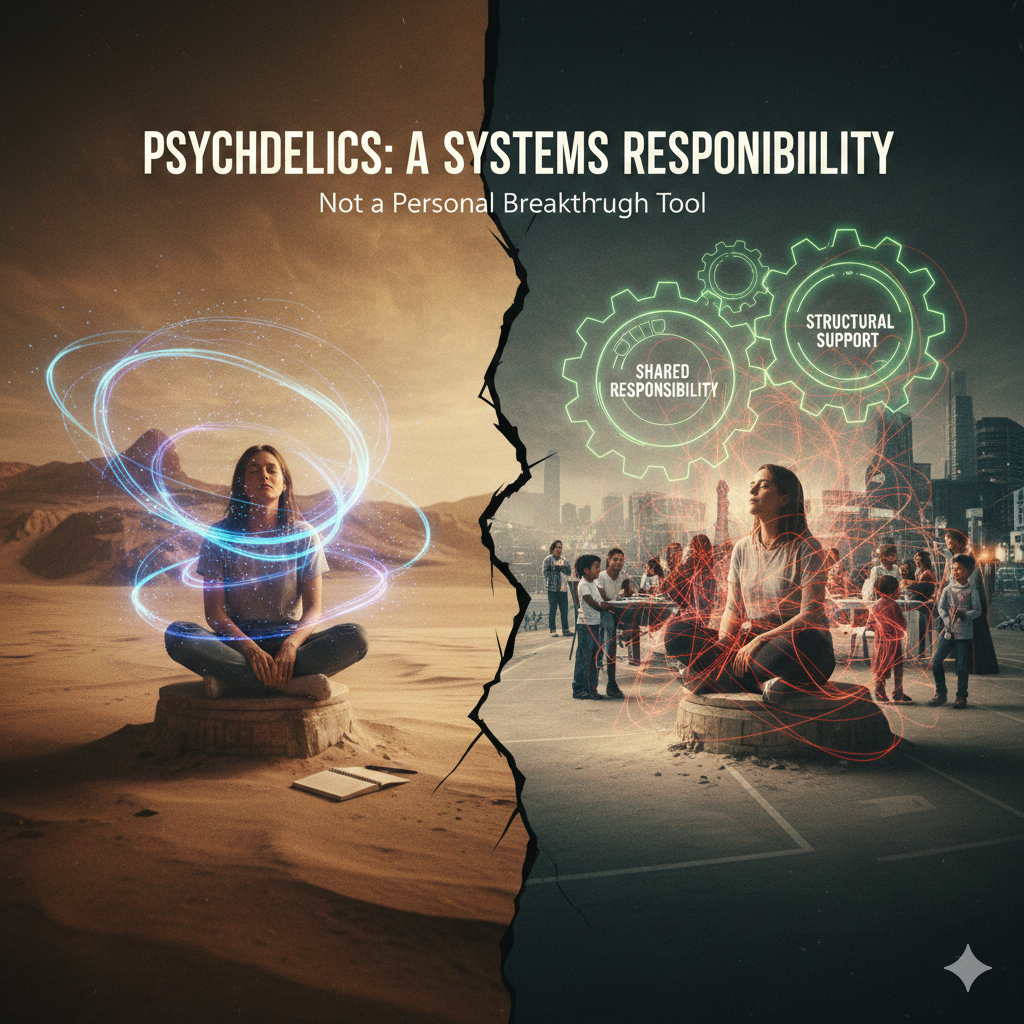
For clinicians, practitioners, and regulators, psychedelics must be understood not as isolated peak experiences but as systemic interventions. These substances do not act on individuals in a vacuum. They interact with families, workplaces, cultures, legal structures, and care systems. When we fail to account for those systems, we shift risk downward and responsibility away from the very institutions that enable these experiences.


The Fallacy of the Isolated Journey

The “isolated journey” narrative is appealing because it is simple. One person. One session. One breakthrough.


But this framing ignores a fundamental truth: psychedelics reliably dissolve boundaries, not only within the psyche but between the individual and their environment. Values shift. Identity loosens. Relationships are reinterpreted. Authority structures are questioned. Meaning is re-authored.


When systems remain unchanged but the individual is altered, friction is inevitable.


A clinician may see a powerful insight and call the session a success. A facilitator may celebrate emotional catharsis. Yet the real test begins afterward, when the individual returns to the systems that shaped them in the first place. Insight without structural support is not healing; it is exposure.


Family, Work, and Cultural Re-Entry Failures

Most harm does not occur during psychedelic sessions. It occurs during re-entry.


A person returns home with new boundaries, but their family system is unchanged.


They return to work with a reoriented sense of purpose, but the organization still rewards compliance over coherence.


They return to a culture that has no language for non-ordinary states, no rituals for integration, and no tolerance for ambiguity.

We call this “integration work,” but too often we treat it as an individual responsibility. Meditate more. Journal longer. Find a coach. Regulate yourself back into systems that have not earned your regulation.


This is a category error. Re-entry is not a personal failure. It is a systems failure.


If psychedelics reliably increase sensitivity, authenticity, and boundary awareness, then unsupported re-entry can destabilize marriages, careers, and identities. When this happens, the individual is often pathologized for “not integrating well,” when in reality they are encountering the limits of their environment.


Organizational Responsibility for Downstream Effects

Psychedelics do not end when the session ends. Neither does responsibility.


Clinics, training programs, retreat centers, and regulatory bodies all participate in shaping downstream outcomes. When they design care models that stop at the moment of insight, they externalize risk onto the participant’s life.


A systems-responsible model asks harder questions:


What happens when someone’s values change faster than their economic reality?
What support exists when insight disrupts relational contracts?
What governance structures are in place when meaning-making accelerates but social context does not?


Healthcare systems would never approve a surgical intervention without post-operative care, yet psychedelic care models routinely do the equivalent. The result is predictable: avoidable harm, silent suffering, and a growing gap between promise and practice.


Why “Personal Insight” Is Not a Care Model

Insight is not treatment. Insight is not integration. Insight is not stability.


Insight is raw material.


Without relational scaffolding, cultural containers, and longitudinal support, insight can become disorganizing rather than liberating. It can isolate individuals from their communities. It can erode trust in institutions without offering viable alternatives. It can leave people awake but alone.


For regulators, this is not a philosophical concern; it is a governance issue. Any intervention that predictably alters worldview, identity, and relational dynamics must be evaluated at the systems level. Risk assessment must include social destabilization, not just acute physiological safety.


For clinicians and practitioners, this requires a shift in professional identity. The role is not to facilitate awakening and step away. It is to steward transitions across time, context, and relationship.


A Systems-Oriented Call to Action

If your model ends when the session ends, it is incomplete by design.


  • Psychedelic leadership demands a broader frame of care:
  • Design integration as a shared responsibility, not an individual burden.
  • Account for family, workplace, and cultural systems as part of the therapeutic field.
  • Extend care models beyond insight into sustained, supported re-entry.
  • Align regulatory standards with the real scope of impact, not the narrow window of administration.


This is not about slowing progress. It is about maturing it.

Psychedelics reveal what systems conceal. That makes them powerful. It also makes them dangerous when treated casually. The future of this field depends not on deeper journeys, but on deeper responsibility.


Transformation does not happen in isolation. Neither should care.


ABOUT THE AUTHOR


Silent


Silent provides the tools for seekers to recognize their path and enables self-reliance for spiritual and magickal growth. 


Seekers gain insight from his work and find their inner calm from his ability to listen and help others reflect.

By Silent January 21, 2026
Tone at the Top | For clinicians, regulators, and practitioners There is an uncomfortable truth circulating quietly through conference halls, investor decks, clinics, and regulatory briefings alike: the psychedelic field is moving faster than the human systems that support it. Everyone feels it. Few are naming it plainly. This is not an argument against growth. Nor is it nostalgia for a pre-commercial past that never truly existed. Psychedelic substances have always lived at the intersection of healing, power, culture, and economy. What has changed is the velocity and the incentives driving it. Today’s growth curve rewards speed, branding, and market capture far more than clinical depth, ethical maturity, or long-term integration. That imbalance is no longer theoretical. It is structural. And it is beginning to show. Venture Timelines vs. Human Integration Timelines Capital moves on quarters. Humans do not. Venture-backed timelines demand proof points: indications approved, clinics opened, patient throughput increased, IP secured. These pressures shape everything downstream, from trial design to therapist training to how outcomes are defined. But psychedelic care unfolds on a different clock. Integration is nonlinear. Adverse experiences may surface months later. Meaning-making does not obey revenue models. A treatment that “works” at week six may unravel at month six if the container is thin. Clinicians see this tension daily. Practitioners feel it in their bodies. Regulators sense it in the growing gap between protocol compliance and lived reality. When financial timelines compress human processes, the risk is not inefficiency; it is harm that arrives quietly, after the dashboards are green. Brand Narratives Masking Structural Weakness In a crowded market, story becomes currency. Words like healing, transformation, and revolution now appear more frequently in pitch decks than in clinical supervision. The aesthetic of care, soft lighting, indigenous symbolism, carefully curated language, can give the impression of depth without the burden of building it. Brand narratives can temporarily substitute for infrastructure. They can smooth over under-trained facilitators, thin integration pathways, or governance models that treat ethics as an appendix rather than a spine. This is not cynicism; it is pattern recognition. When narrative runs ahead of operational maturity, organizations borrow trust instead of earning it. Borrowed trust always comes due. The Monetization of Mystique Psychedelics carry something rare in modern medicine: mystery. That mystery is not a flaw, it is part of their power. But mystery, once monetized, becomes fragile. The field now sells access not only to molecules, but to meaning itself. Retreats promise insight. Clinics promise rebirth. Platforms promise scalability of the ineffable. When mystique becomes a revenue driver, two distortions emerge. First, expectations inflate beyond what any ethical clinician would guarantee. Second, adverse outcomes are reframed as user failure rather than system responsibility. This dynamic quietly erodes informed consent. Patients are no longer entering treatment; they are entering a narrative they feel pressured to fulfill. What Happens When Trust Collapses Trust is the invisible substrate of this entire ecosystem. Patients extend trust not just to clinicians, but to institutions, regulators, and the unspoken promise that someone has thought deeply about second- and third-order effects. When trust collapses, it does not do so symmetrically. Patients withdraw first. Then clinicians disengage. Regulators respond last, but decisively. History offers no shortage of examples where promising therapeutic modalities were set back decades, not because they failed clinically, but because they failed ethically under pressure. A single high-profile breach, poor screening, inadequate integration, conflicts of interest obscured by branding, can reset the entire regulatory climate. Trust, once broken, is not rebuilt by marketing. It is rebuilt by restraint. The Leadership Question No One Can Avoid This is not a frontline problem. It is a leadership problem. Boards, executives, principal investigators, and policy architects are shaping incentive structures right now that will determine whether this field matures, or fractures. The question is not can we grow? The question is what kind of growth are we legitimizing? True leadership in this space requires resisting false binaries. It is possible to be commercially viable and clinically rigorous. It is possible to scale and still protect the slow, human work of integration. But it requires governance models that value delay as much as delivery. It requires metrics that track downstream well-being, not just upstream access. It requires saying “not yet” when the market is shouting “now.” Call to Action: Slow Growth Is Not Failure Let us be precise. Slow growth is not failure. Careful sequencing is not weakness. Ethical friction is not inefficiency. Unexamined growth, however, is a liability. For clinicians: protect your boundaries even when demand surges. For practitioners: name when the container is thinning.  For regulators: resist pressure to equate speed with progress. For leaders: build systems worthy of the states you are unleashing. This field does not need more momentum. It needs more maturity. The real question is not whether psychedelics will change medicine. They already have. The question is whether the industry built around them will earn the right to last.
By Silent January 19, 2026
There is a dangerous myth circulating in the psychedelic renaissance: that growth itself is proof of virtue. More clinics, more facilitators, more capital, more throughput. The assumption is subtle but corrosive—if the intention is healing, then scale must be good. History, biology, and human psychology disagree. Premature scaling in psychedelics doesn’t announce itself with scandals or body bags. It leaves quieter casualties. Harm here is diffuse, delayed, and therefore easy to deny. That does not make it hypothetical. It makes it systemic. When systems grow faster than their ethics, their governance, and their capacity to metabolize harm, people pay the price. We just rarely count them. Why Adverse Outcomes Rarely Surface in Metrics Most psychedelic organizations measure what is convenient: session counts, revenue growth, waitlists, completion rates, Net Promoter Scores. These metrics create the illusion of health. They tell you how many people passed through the system, not how many were quietly destabilized by it. Adverse outcomes in psychedelic work often emerge weeks or months later. Integration failures don’t show up in post-session surveys. Spiritual disorientation, retraumatization, or identity destabilization rarely translate into customer complaints. Instead, they manifest as disengagement, silence, or shame. The system interprets this absence of data as success. But silence is not the same as safety. A field that prides itself on non-ordinary states should not rely on ordinary metrics. If your dashboards cannot capture delayed psychological harm, relational fallout, or existential distress, then you are not measuring outcomes—you are measuring throughput. Moral Injury Among Practitioners The first casualties of premature scaling are often the practitioners themselves. Facilitators are asked to hold more clients, move faster, follow rigid protocols, and suppress intuition in favor of standardization. They are told this is “professionalization.” What it often is, is moral compression. When practitioners feel forced to deliver experiences they know are unsafe, rushed, or poorly integrated, something fractures internally. This is moral injury—not burnout, not fatigue, but the slow erosion of one’s ethical center. Moral injury doesn’t show up in HR metrics either. It shows up as dissociation, cynicism, emotional numbing, or quiet exits from the field. The system absorbs the loss and hires replacements. The pattern repeats. A field built on healing cannot afford to normalize ethical self-betrayal among its stewards. Patients Who Disappear Instead of Complain In traditional healthcare, dissatisfied patients file complaints. In psychedelic work, harmed participants disappear. They blame themselves. They assume they “did it wrong,” weren’t ready, or failed the medicine. Many are already carrying trauma histories that predispose them to internalize harm rather than externalize it. So they don’t sue. They don’t post reviews. They don’t alert regulators. They simply vanish—often destabilized, sometimes worse than when they entered. A system that only listens for noise will never hear these people. And a system that equates silence with success is actively training itself not to see harm. Regulatory Backlash Cycles Here is the pattern regulators know well: An industry expands faster than its safeguards. Harm accumulates quietly. Then something breaks loudly. A death. A scandal. A whistleblower. A media exposé. The response is never nuanced. It is blunt, reactionary, and often punitive. Entire programs get shut down. Legitimate work is swept up with negligent practice. The pendulum swings from permissive to prohibitive. The psychedelic field is not exempt from this cycle. In fact, it is uniquely vulnerable because its harms are harder to quantify and easier to sensationalize once exposed. If you do not govern yourself rigorously, someone else will do it for you—with far less understanding and far more force. The Cost of Silence Silence is expensive. It just doesn’t show up on financial statements. It costs practitioners their integrity. It costs participants their trust. It costs the field its credibility. Every time an organization chooses growth over readiness, speed over stewardship, or optics over truth, it accrues a debt. That debt is paid later—by people who are no longer in the room to complain. Leadership is not proven by how fast you scale. It is proven by what you refuse to scale before the system is ready. Call to Action Measure what is inconvenient before regulators measure it for you. Track delayed outcomes. Create formal mechanisms for reporting harm without penalty or shame. Monitor practitioner moral distress as a leading indicator, not an HR footnote. Slow down when your governance lags behind your ambition. If your model cannot tolerate these measurements, it cannot tolerate reality. Growth is not the enemy. Premature growth is. And pretending the casualties don’t exist does not make the work sacred—it makes it negligent. Tone at the top is not about vision statements or values decks. It is about what you are willing to see, name, and be accountable for—especially when it threatens the story you want to tell.  Onward.
By Silent January 16, 2026
Thesis: Variable practitioner competence is not an inconvenience, it is the single largest threat to legitimacy, safety, and public trust in psychedelic and spiritually informed care. The psychedelic and spiritual-care fields are standing at a familiar threshold: rapid growth, cultural fascination, and fragile legitimacy. History tells us what comes next. Industries do not collapse because of bad intentions; they collapse because they mistake charisma for competence and belief for skill. Right now, the most dangerous myth circulating in this space is that good intentions plus altered states equal good care. They do not. If we are honest, the greatest risk to clients is not the medicine. It is the practitioner. The Myth of Innate “Holding Capacity” “Holding capacity” has become a flattering euphemism for intuition without discipline. The belief goes something like this: some people are naturally gifted at presence, containment, and spiritual depth, and therefore need less training. This myth is seductive, especially in traditions that valorize awakening experiences or lineage transmission. But capacity is not a personality trait. It is a trained function under stress. True holding emerges when a practitioner can remain regulated while another person dissociates, regresses, rages, or collapses into grief. It shows itself when the room destabilizes, not when everything feels sacred and aligned. Assuming that inner work automatically translates into clinical or spiritual containment is not just naive, it is negligent. In psychotherapy, we learned this lesson the hard way. Empathy without structure burns out practitioners and harms clients. Psychedelic states amplify this risk by orders of magnitude. Weekend Certifications and Spiritual Bypass The industry’s quiet scandal is how quickly authority is conferred. A few weekends. A certificate. A website. Suddenly someone is “facilitating deep transformation.” Short-form trainings are not inherently wrong. The problem is when they substitute for longitudinal development. Many programs teach language, frameworks, and rituals without confronting the practitioner’s unresolved material or stress responses. The result is spiritual bypass dressed up as professionalism. Clients sense this immediately. When a practitioner reflexively reframes trauma as “medicine teaching,” or rushes to meaning-making before nervous systems stabilize, trust erodes. What looks like wisdom is often avoidance. No amount of ceremonial fluency compensates for an inability to tolerate ambiguity, fear, or silence without imposing an interpretation. Skill Decay Without Supervision Competence is perishable. Every field that takes safety seriously accepts this. Surgeons, pilots, psychotherapists, all require ongoing supervision, peer review, and continuing education. Psychedelic and spiritual care is no different, except the industry often behaves as if awakening inoculates against error. It does not. Without supervision, blind spots calcify. Boundary drift becomes normalized. Subtle countertransference goes unchecked until it becomes harm. Practitioners begin practicing alone in echo chambers, mistaking confidence for mastery. Supervision is not a punishment. It is the infrastructure that keeps humility operational. Lessons from Psychotherapy Licensure Failures It is tempting to assume that psychotherapy offers a gold standard. It does not, but its failures are instructive. Licensure did not eliminate misconduct; it merely made patterns visible and accountable. Where supervision was strong, harm decreased. Where it was absent or perfunctory, abuses persisted. The psychedelic field risks repeating early psychotherapy’s mistakes at accelerated speed. Fewer safeguards. Higher intensity states. Less shared language for accountability. The question is not whether regulation will come. It is whether the field will mature before regulation is imposed after harm. What Competent Training Actually Requires Real training is inconvenient. It takes time. It humbles people. It exposes weaknesses that branding prefers to hide. At minimum, competent preparation requires: · Extended supervised practice , not simulated role-play alone · Assessment of practitioner regulation under pressure , not just knowledge recall · Ongoing mentorship and case consultation , not one-time certification · Explicit boundary education , including power, dependency, and transference · Clear pathways for remediation , not silent exclusion or denial Most importantly, it requires a cultural shift: from identity-based authority (“I am called to this work”) to function-based responsibility (“I can demonstrate this capacity reliably”). The Real Cost of Ignoring the Gap Every adverse event, every client harmed, every story whispered but not addressed, erodes public trust. And once trust is lost, it does not return easily. The backlash will not distinguish between good actors and bad structures. It never does. This field has a narrow window to decide what it wants to be known for: transformation with rigor, or inspiration without accountability. Call to Action If you cannot defend your training standards under cross-examination, they are not standards. Not to a journalist. Not to a regulator. Not to a grieving family asking why harm occurred under your watch. Depth without discipline is not wisdom. It is risk .  And the future of this work depends on whether we are willing to say that out loud, now, before someone else says it for us.
Show More