Awakening Your Inner Magus
Silent • July 23, 2024

Personal Growth and Transformation for the Malewitch

Personal growth and transformation in witchcraft involve evolving spiritually and emotionally, harnessing inner power, and aligning with natural and divine forces to achieve profound self-realization.


In the spirit of every malewitch lies the potential for profound personal growth and transformation. While everyone looks for growth and transformation, male presenting (I’ll use men or males in the future in this article), people have specific challenges we’ll outline.


As we journey through life, from the vigor of youth at sixteen to the seasoned wisdom of forty and beyond, we are called to awaken the inner magus and embrace the continuous evolution of our spiritual and personal selves. This sacred journey is not merely a path walked but a dance with the divine, a harmonious blend of emotions, self-discovery, empowerment, and mystical connection.


And there’s the rub. Today’s society deemphasizes emotions and looks inward, especially for young men. This trend has been prevalent for several generations.

The question to ask yourself is, what comes after transformation? Who do I want to be? How do I want to feel about myself? When I present myself authentically to the world, am I authentic, and how will/should they respond to me? Setting intentions and creating goals while you explore is essential.


Big questions.

The essence of personal growth for the malewitch begins with self-awareness.

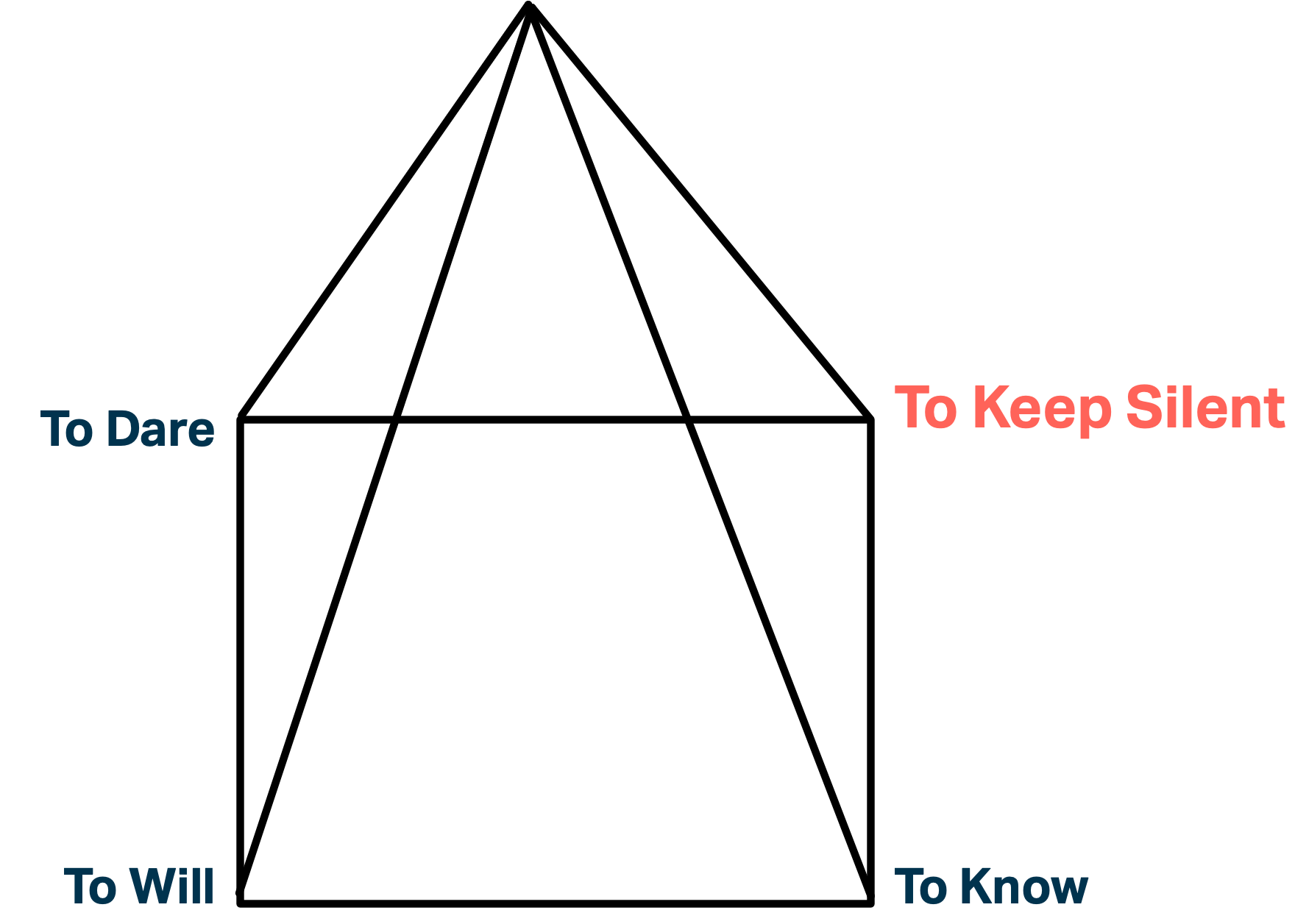
I’m not a big fan of typing systems (e.g., Myers-Briggs, DISC, Enneagrams). A subsequent article about that and the Barnum effect is forthcoming. The Witches Pyramid is a good framework for examining oneself without typing.

To know oneself is the foundation of all magick. Engage deeply with your inner world, examining your strengths, shadows, and desires. Reflect through journaling, meditation, and ritual. These practices illuminate the unseen facets of your psyche, guiding you to a deeper understanding of who you are and what you seek in this lifetime.


As you grow in self-awareness, the next step is to cultivate willpower. The malewitch must harness his inner fire, the will to enact change and manifest his desires.


This is the principle of To Will in the Witch’s Pyramid. Focused intent is the heart of all magickal workings. Whether setting goals in your mundane life or casting spells for transformation, your will is the engine that drives success. Regular practice of magick, setting clear intentions, and unwavering commitment to your goals will fortify your willpower.


Daring (To Dare) to dream and act upon those dreams is another pivotal aspect of transformation. The path of the malewitch requires courage. It is the courage to step into the unknown, to face fears, and to challenge societal norms. This daring spirit propels you forward, breaking the chains of limitation and opening the door to endless possibilities. Embrace challenges as opportunities for growth, and remember that every obstacle is a lesson in disguise.


The journey of personal growth for the malewitch is also deeply intertwined with the natural world. Nature is our greatest teacher and ally. Spend time in the wild, attuning yourself to the rhythms of the Earth. Observe the cycles of the moon, the changing seasons, and the elements. These natural forces mirror your inner growth, decay, and rebirth cycles. By aligning with nature, you tap into a wellspring of wisdom and power that fuels your transformation.


Additionally, community and mentorship play crucial roles in developing a malewitch. Seek out like-minded individuals and elders who can guide you. Engaging in communal rituals, sharing knowledge, and supporting each other creates a tapestry of collective wisdom and strength. Remember, you are not alone on this path. The shared journey enriches your experience and fosters a sense of belonging and purpose.


Finally, embody silence. The principle of To Be Silent is about introspection, humility, and inner peace.


The most profound insights and transformations occur in quiet moments of reflection. Knowing when to speak is equally as important as knowing when not to. Silence allows you to listen to the whispers of the divine, to your inner voice, and to the subtle energies that guide your path. Embrace solitude as a sacred practice and let it be a source of profound personal revelation. Like The Hermit card, you can stop being alone at any time you wish.


In conclusion, the journey of personal growth and transformation for the malewitch is a sacred tapestry woven with threads of self-awareness, willpower, courage, nature, community, and silence. Embrace this path with an open heart and a steadfast spirit.


Your evolution is a personal triumph and a beacon of magickal potential for all who walk this path. Let the inner magus within you rise, transforming your life and world mystically and magnificently.


Blessings on your journey.

ABOUT THE AUTHOR


Silent


Silent provides the tools for seekers to recognize their path and enables self-reliance for spiritual and magickal growth. 


Seekers gain insight from his work and find their inner calm from his ability to listen and help others reflect.

By Silent June 12, 2026
Walk into any forest in the Cascades and you are standing on the dead. The fir that fell forty years ago is now the nurse log feeding a row of saplings. The salmon carried uphill by an eagle became the nitrogen in the cedar's needles. Nothing in that forest is wasted, and nothing in it is afraid. We have built an entire industry on pretending we are exempt from this. We drain the body of its blood, fill it with preservatives, seal it in lacquered hardwood, and lower it into a concrete vault—as if the earth were a contamination to be defended against rather than the place we came from. Cremation, for all its simplicity, burns fossil fuel and sends the body skyward as carbon. There is another way, and it began here in Washington. Human composting—the law calls it natural organic reduction—was legalized in this state in 2019, the first in the nation. The process is unhurried and honest. The body, unembalmed, is laid into a steel vessel and surrounded by wood chips, alfalfa, and straw. No chemicals are added. The microbes that already live on the plant material, and on us, do the work they have always done. Over eight to twelve weeks, the body becomes soil—about a cubic yard of it, dark and alive. Families may take some home for a garden or a tree, or donate it to forest conservation land. What was a person becomes, quite literally, ground for new growth. I have sat with the dying, and I can tell you that the question underneath most deathbed fear is not what happens to me? It is did I matter, and will anything of me remain? The Hávamál answers plainly: cattle die, kin die, the self dies too—but what one leaves behind endures. We usually read that as reputation. I have come to read it more literally. A body that becomes soil leaves something behind that you can hold in your hands. Something that feeds. For those of us who keep the old ways, this is not innovation. It is restoration. Our ancestors were returned to barrows and bogs and burial mounds, given back to the land that fed them. The vessel and the alfalfa are new; the covenant is ancient. The earth gives, and the earth receives. Every harvest festival we keep is built on that exchange. It would be strange to honor the cycle all our lives and then opt out of it at the end. This choice is now legal in a dozen states and counting. If it speaks to you, say so—out loud, in writing, to the people who will one day carry out your wishes. Death plans left unspoken become burdens; death plans spoken become gifts. A leaf falls. A seed sprouts. The tree does not grieve the leaf, and the soil does not refuse the seed. When my own time comes, I intend to be useful one last time. That, too, is a kind of prayer.  —Silent
By Silent May 28, 2026
For the Pagan and Contemplative Community
By Silent May 27, 2026
There is a grief that arrives before the death. It does not announce itself. It does not have a name that anyone uses at the dinner table, or in the waiting room, or in the parking lot of the care facility where you sit in your car for a few minutes before going in, gathering yourself. It lives in small moments. The first time they didn't recognize you. The day you realized you were making decisions for them that they would have hated. The night you caught yourself hoping — just for a second, just once — that it would be over soon, and then spent the next three days punishing yourself for the thought. This is called anticipatory grief. And it is real, and it is heavy, and almost no one will name it for you while you are living inside it, because you are the strong one, and the person you are losing is still here, and grief, we have been told, comes after. It doesn't always come after. Sometimes it comes alongside. Caregiving is one of the most demanding things a human being can do. It asks you to be present to someone else's diminishment, day after day, while managing your own fear and your own exhaustion and your own sadness — and while the world around you continues as though nothing unusual is happening. You go to the grocery store. You answer emails. You show up. You are praised for your strength, which is a kindness people offer because they don't know what else to give you. What you actually need is someone who will let you put the strength down for an hour. Not fix you. Not give you a plan. Not tell you that you're doing a great job, or that they couldn't do what you're doing, or that everything happens for a reason. Just someone who will sit with you in the weight of it. Who will not be frightened by what you are carrying. Who will let you say the unsayable things — the anger, the ambivalence, the love that is so tangled up with loss that you can no longer tell them apart. That is what I offer. I am a death doula and spiritual director. I work with caregivers who are in the middle of it — not at the end, not after, but now, in the long middle stretch where the grief has no official start date and the world has not yet given you permission to feel it. We meet, usually by video, for an hour at a time. I listen in a particular way — not for problems to solve, but for what is actually present beneath the exhaustion and the competence and the careful management of everyone else's emotions. You do not have to have it together when you come into this space. That is the point of it. A few things I will not do: I will not tell you how to grieve correctly. There is no correctly. I will not rush you toward acceptance or silver linings. Some things do not have silver linings, and pretending otherwise is a small violence. I will not give you more to manage. You are already managing too much. What I will do is be present — fully, unhurriedly, without an agenda — for whatever you bring into the room. If you are a caregiver and you are reading this and something in you recognized itself in these words, that recognition is an invitation.  I have a small number of spaces available for caregivers who are navigating the approach of death alongside someone they love. The intake questions at tokeepsilent.me are where we begin. Or you can reach me directly. There is no script for this conversation. We simply start. — Silent
Show More