You Are Already Grieving. No One Has Said So Yet.
Silent • May 27, 2026

There is a grief that arrives before the death.


It does not announce itself. It does not have a name that anyone uses at the dinner table, or in the waiting room, or in the parking lot of the care facility where you sit in your car for a few minutes before going in, gathering yourself.


It lives in small moments. The first time they didn't recognize you. The day you realized you were making decisions for them that they would have hated. The night you caught yourself hoping — just for a second, just once — that it would be over soon, and then spent the next three days punishing yourself for the thought.


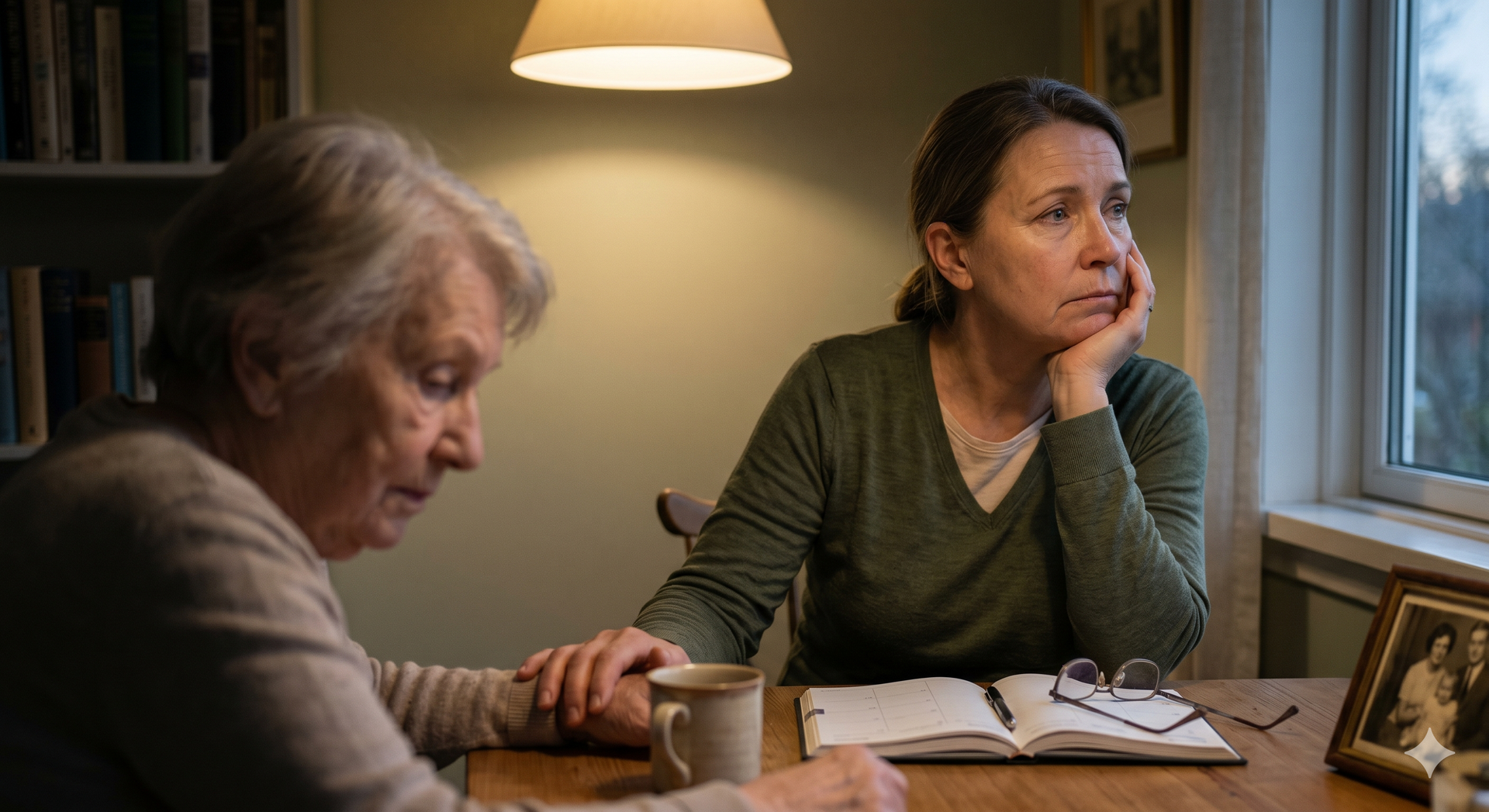
This is called anticipatory grief. And it is real, and it is heavy, and almost no one will name it for you while you are living inside it, because you are the strong one, and the person you are losing is still here, and grief, we have been told, comes after.


It doesn't always come after. Sometimes it comes alongside.


Caregiving is one of the most demanding things a human being can do. It asks you to be present to someone else's diminishment, day after day, while managing your own fear and your own exhaustion and your own sadness — and while the world around you continues as though nothing unusual is happening.


You go to the grocery store. You answer emails. You show up. You are praised for your strength, which is a kindness people offer because they don't know what else to give you.


What you actually need is someone who will let you put the strength down for an hour.


Not fix you. Not give you a plan. Not tell you that you're doing a great job, or that they couldn't do what you're doing, or that everything happens for a reason.


Just someone who will sit with you in the weight of it. Who will not be frightened by what you are carrying. Who will let you say the unsayable things — the anger, the ambivalence, the love that is so tangled up with loss that you can no longer tell them apart.


That is what I offer.


I am a death doula and spiritual director. I work with caregivers who are in the middle of it — not at the end, not after, but now, in the long middle stretch where the grief has no official start date and the world has not yet given you permission to feel it.


We meet, usually by video, for an hour at a time. I listen in a particular way — not for problems to solve, but for what is actually present beneath the exhaustion and the competence and the careful management of everyone else's emotions.


You do not have to have it together when you come into this space. That is the point of it.


A few things I will not do:


I will not tell you how to grieve correctly. There is no correctly.


I will not rush you toward acceptance or silver linings. Some things do not have silver linings, and pretending otherwise is a small violence.


I will not give you more to manage. You are already managing too much.

What I will do is be present — fully, unhurriedly, without an agenda — for whatever you bring into the room.


If you are a caregiver and you are reading this and something in you recognized itself in these words, that recognition is an invitation.


I have a small number of spaces available for caregivers who are navigating the approach of death alongside someone they love.


The intake questions at tokeepsilent.me are where we begin. Or you can reach me directly. There is no script for this conversation. We simply start.

— Silent

ABOUT THE AUTHOR


Silent


Silent provides the tools for seekers to recognize their path and enables self-reliance for spiritual and magickal growth. 


Seekers gain insight from his work and find their inner calm from his ability to listen and help others reflect.

By Silent May 24, 2026
You have prepared for everything. The board presentation. The acquisition. The restructuring conversation you had to have with someone you respected. The market downturn you saw coming and the one you didn’t. You have sat in rooms where the stakes were real and kept your composure, and you have learned — through repetition and cost — how to carry weight without showing it. You have not prepared for this. No one does. Not really. The death of a parent, a spouse, a peer your own age. A diagnosis with a timeline attached. The slow, grinding recognition that someone you love is leaving — not suddenly, but in increments, and there is nothing to negotiate, no alternative proposal to bring to the table, no strategic pivot available. This is not a problem to be solved. It is a threshold to be crossed. And most people cross it alone, or nearly so — surrounded by well-meaning people who don’t know what to say, medical professionals focused on the body, and a culture that has made death so invisible that we have lost the language for it entirely. I am a death doula. That phrase means different things in different contexts. In mine, it means this: I sit with people who are navigating the approach of death — their own or someone they love — and I offer skilled, unhurried companionship for the crossing. Not therapy. Not hospice care. Not grief counseling, though grief is present in every conversation. What I offer is something older than all of those things. It is the human practice of bearing witness — of being present without flinching, without fixing, without rushing anyone toward a resolution they are not ready for. I work with a small number of people at a time, by referral and by invitation. My clients are often high-functioning, highly capable people who have spent their professional lives solving problems and have arrived at the one thing that will not be solved. They need someone who will not be undone by its weight. Someone who has sat with death before and is not afraid of it. That is what I am. The work looks different for each person. Sometimes it is sitting with a CEO whose mother is in hospice and who has not yet cried — not because he doesn’t feel it, but because he doesn’t know how to begin, and the people around him need him to be okay. We create a space where he does not have to be okay. That is the whole of it. Sometimes it is working with a woman who received a diagnosis six months ago and has been managing everyone else’s feelings about it ever since. We turn that around. For one hour, no one else’s feelings matter. Only hers. Sometimes it is a caregiver — a spouse, an adult child — who is exhausted in a way that sleep does not fix, carrying a grief that has not been permitted to be grief yet because the person they are losing is still here. We name that. We sit with it. We find language for what has no name. Sometimes it is preparation for the dying person themselves, or for those who will remain. What needs to be said. What needs to be forgiven? What can be laid down before the end, and what must be carried. Death is not the enemy of a good life. It is its completion. But we have forgotten how to treat it that way. We have medicalized it, hidden it, rushed past it, outsourced it entirely. And so when it arrives — as it always does — we find ourselves without a map, without a guide, without the language for what we are experiencing. You do not have to cross this threshold without accompaniment. If you are navigating the approach of death — your own or someone you love — and you are looking for skilled, unhurried companionship, I have a small number of spaces available. Begin with the intake questions at tokeepsilent.me , or simply reach out directly. There is no wrong way to begin this conversation.  — Silent
By Silent April 23, 2026
Learn how spiritual direction helps leaders manage grief & navigate change. Seek support for your organizational restructuring today.
By Silent April 22, 2026
This is a subtitle for your new post
Show More