The Meeting You Will Never Prepare For
Silent • May 24, 2026

You have prepared for everything.


The board presentation. The acquisition. The restructuring conversation you had to have with someone you respected. The market downturn you saw coming and the one you didn’t. You have sat in rooms where the stakes were real and kept your composure, and you have learned — through repetition and cost — how to carry weight without showing it.


You have not prepared for this.


No one does. Not really. The death of a parent, a spouse, a peer your own age. A diagnosis with a timeline attached. The slow, grinding recognition that someone you love is leaving — not suddenly, but in increments, and there is nothing to negotiate, no alternative proposal to bring to the table, no strategic pivot available.


This is not a problem to be solved. It is a threshold to be crossed.

And most people cross it alone, or nearly so — surrounded by well-meaning people who don’t know what to say, medical professionals focused on the body, and a culture that has made death so invisible that we have lost the language for it entirely.


I am a death doula.


That phrase means different things in different contexts. In mine, it means this: I sit with people who are navigating the approach of death — their own or someone they love — and I offer skilled, unhurried companionship for the crossing.


Not therapy. Not hospice care. Not grief counseling, though grief is present in every conversation.


What I offer is something older than all of those things. It is the human practice of bearing witness — of being present without flinching, without fixing, without rushing anyone toward a resolution they are not ready for.


I work with a small number of people at a time, by referral and by invitation. My clients are often high-functioning, highly capable people who have spent their professional lives solving problems and have arrived at the one thing that will not be solved. They need someone who will not be undone by its weight. Someone who has sat with death before and is not afraid of it.


That is what I am.


The work looks different for each person.


Sometimes it is sitting with a CEO whose mother is in hospice and who has not yet cried — not because he doesn’t feel it, but because he doesn’t know how to begin, and the people around him need him to be okay. We create a space where he does not have to be okay. That is the whole of it.

Sometimes it is working with a woman who received a diagnosis six months ago and has been managing everyone else’s feelings about it ever since. We turn that around. For one hour, no one else’s feelings matter.


Only hers.


Sometimes it is a caregiver — a spouse, an adult child — who is exhausted in a way that sleep does not fix, carrying a grief that has not been permitted to be grief yet because the person they are losing is still here.


We name that. We sit with it. We find language for what has no name.


Sometimes it is preparation for the dying person themselves, or for those who will remain. What needs to be said. What needs to be forgiven? What can be laid down before the end, and what must be carried.


Death is not the enemy of a good life. It is its completion.


But we have forgotten how to treat it that way. We have medicalized it, hidden it, rushed past it, outsourced it entirely. And so when it arrives — as it always does — we find ourselves without a map, without a guide, without the language for what we are experiencing.


You do not have to cross this threshold without accompaniment.


If you are navigating the approach of death — your own or someone you love — and you are looking for skilled, unhurried companionship, I have a small number of spaces available.


Begin with the intake questions at tokeepsilent.me, or simply reach out directly. There is no wrong way to begin this conversation.


— Silent

ABOUT THE AUTHOR


Silent


Silent provides the tools for seekers to recognize their path and enables self-reliance for spiritual and magickal growth. 


Seekers gain insight from his work and find their inner calm from his ability to listen and help others reflect.

By Silent • October 4, 2026
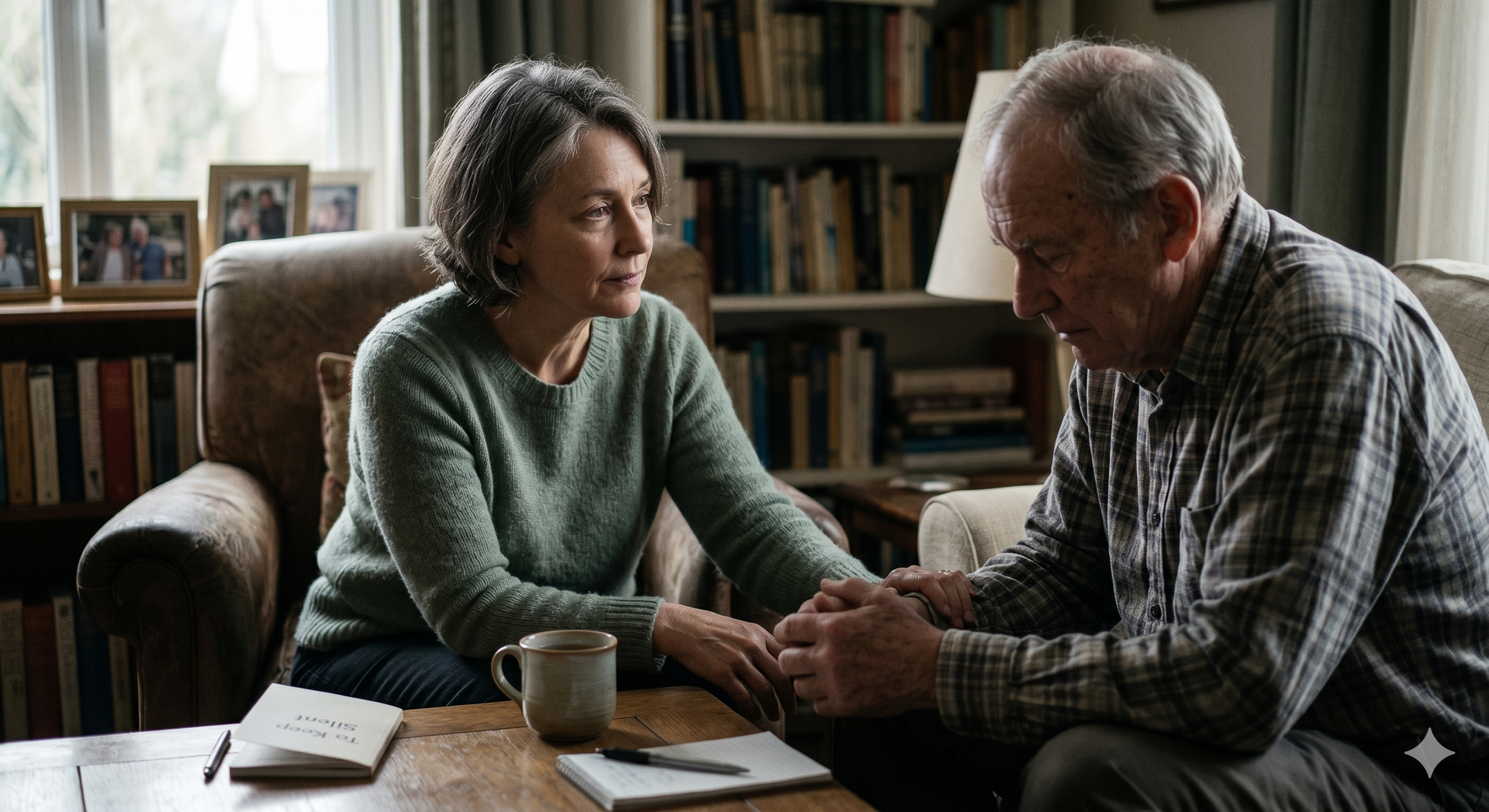
Four weeks before Samhain, a recent study of grief technology and a 4,000-year-old household ritual ask the same question: where does love go when its person has died?
By Silent • September 26, 2026
A new study of American religious life shows belief eroding even inside the tradition best known for keeping its people — and asks what's actually left once certainty goes. On September 22nd, Pew Research Center published one of the more quietly startling religion studies of the year, and it isn't about a fringe group or a sect nobody expected to hold together. It's about the Church of Jesus Christ of Latter-day Saints — a faith practically famous for how thoroughly it keeps its own. In 2007, seven in ten Americans raised Mormon still identified as Mormon in adulthood. By 2023–24, that number had fallen to fifty-four percent. Nearly a third of those raised in the faith now describe themselves as atheist, agnostic, or "nothing in particular" — double the share sixteen years earlier. Even among those who stayed, certainty thinned: belief in God "without doubt" dropped from ninety percent to seventy-six, daily prayer from eighty-two to seventy-three. I want to handle this data carefully. It's easy to hear "church retention falls" as bad news for the faithful, or quiet vindication for everyone else. Both readings miss the point. LDS retention, even diminished, still outperforms most American denominations. This isn't a story about one institution losing its grip. It's a story about certainty tested under close to the best conditions available to it — strong community, generational continuity, real doctrinal coherence — and still, gradually, coming apart at the seams. If it can happen there, the architecture holding up anyone's inherited certainty is less permanent than it looks from inside it. What the Study Can't Measure Pew can count who still checks a box on a survey. It can't tell you what it's like to be the one doing the leaving — or the one staying while something you used to feel without effort quietly stops being available to you. That's a different kind of data, and it's the kind spiritual direction actually works with. I've sat across from people in exactly that middle distance: still going through the motions, still loving their community, privately unsure whether anyone is listening. It's one of the loneliest positions a person can occupy, because it often can't be spoken aloud inside the very community that would otherwise hold you. You're not ready to call yourself a leaver. You can't quite call yourself a believer without qualifying it into something smaller. Most traditions have no name for that middle room, so people sit in it alone, assuming they're the only one there. They rarely are. The Pew numbers say so. The Gate You Can't Skip There's an old Sumerian story about Inanna, Queen of Heaven, who descends into the underworld to see her sister Ereshkigal. At each of seven gates, the gatekeeper takes something from her — her crown, her jewelry, her royal robes — until she arrives at the bottom stripped of every marker that told anyone, including herself, who she was. Only then does she meet what's actually down there. The myth doesn't treat this as tragedy. It treats it as the price of admission to a truth the ornaments were never built to survive. Deconstruction, in the modern sense, usually doesn't announce itself as myth. It shows up as a nagging doubt during a hymn, a question you stop asking out loud, a certainty that used to arrive automatically and now has to be manufactured. But it follows the same shape as Inanna's descent: something is removed at every threshold, and there's no route past the gate that lets you keep all your jewelry. The theology goes first, sometimes. Then the community. Then, for some, the habit of feeling addressed by anything larger than themselves. I'm not going to rush in here and repair anyone's faith, and I'd be suspicious of anything that claimed it could. Some absences aren't problems waiting on a solution. The silence where God used to answer immediately isn't necessarily a malfunction — it may be the actual terrain, and the task is learning to stand in it rather than paper over it with a faster answer. The Question Worth Sitting With So here's what I'd actually ask, if you were sitting across from me instead of reading this: if the certainty you were handed finished eroding completely — not into a different, tidier belief, not into an argument you could win, but into open silence — could you survive being someone who simply doesn't know? Not forever. Just for now, while it's true. I won't answer that for you. I don't think it can be answered from outside the room it happens in. A Practice for the Middle Room If you recognize yourself here — still present, quietly uncertain — try this before the week is out. Write one sentence naming exactly what you used to believe without effort. Then write, honestly, whether that sentence is still true for you, true with an asterisk, or no longer true at all. Don't fix it. Don't defend it to an imagined critic. Just let it sit there, accurate, on the page. That's the whole practice. It won't resolve anything tonight. It will at least stop costing you the extra work of pretending, even to yourself, that nothing has moved. Closing Reflection Nearly a third of a generation raised inside one of America's most cohesive faiths now names no faith at all. Whatever tradition raised you, ask honestly: which of your certainties are still yours, and which have you simply kept saying out of habit? Sit with the answer before you try to fix it.
By Silent • September 19, 2026
This week the day and night stand equal for a moment — then the dark begins to win, and so does the question of what you actually belong to.
Show More