The Vision Outlives the Committee
Silent • September 12, 2026

The FDA is spending an afternoon on the future of psychedelic medicine — the harder question, what to do with what you saw, isn't on the agenda.


On September 14th, the FDA will convene a public hearing at its White Oak campus to gather “feedback and perspectives on issues associated with the potential future therapeutic use of drug products containing a psychedelic drug substance in supervised and supportive settings.” There will be an agenda. There will be a public comment period, open through October 5th. There will be binders.


I don’t say this to mock the process. Regulatory caution exists because people have been harmed by its absence, and any responsible path toward legal, supervised psychedelic therapy has to survive contact with lawyers and toxicologists before it survives contact with the rest of us. But there is something quietly strange about a room full of credentialed people trying to determine the proper use case for an experience that, across cultures and centuries, was never really asking anyone’s permission to mean something.


The Committee Cannot Follow You Home

Here is the part the hearing will not address, because it isn’t the FDA’s job to address it: the vision does not end when the session does.


Whether your own encounter happened in a clinical trial, a ceremonial circle, a friend’s living room, or somewhere you’d rather not specify, the pattern is usually the same. Something enormous happens — a door opens, a dead parent speaks, the self dissolves and reassembles slightly differently than before — and then, with very little transition, you are back to traffic, laundry, and an inbox that does not know or care what you just saw.


This is where most of the real work actually lives, and it is work spiritual direction is suited for in a way clinical treatment often isn’t. A therapist may help you process what happened. A physician may monitor what it did to your nervous system. Neither of those is quite the same task as sitting with the question of what a genuine encounter with the numinous is now asking of an ordinary Tuesday. That is discernment, not diagnosis. I want to be clear about the boundary: I am not a medical provider, I do not facilitate sessions, and nothing here should be read as guidance to use a psychedelic substance outside of legal, supervised, medically appropriate settings, or in place of care you’re already receiving. What I can offer is what comes after — the part nobody’s insurance covers.


What the Old Stories Already Knew

Norse tradition preserves a strange image of Odin hanging nine nights on the World Tree, wounded by his own spear, given neither food nor water, in order to receive the runes. It is not framed as a pleasant experience. It is framed as a price. And crucially, the story doesn’t end on the tree. Odin comes down. He takes what he suffered to learn and puts it to use in the ordinary work of ruling, teaching, and preparing for the end he already knows is coming. The vision was never the point. What he did with it was.


That is the lens Spiritual Direction brings to psychedelic experience: not “was it real,” not “was it legal,” but what is this asking of my ordinary life — the question integration actually turns on. A revelation that never leaves the altered state and never touches how you treat your spouse, spend your money, or keep your commitments was, functionally, just a very good story you tell at parties.


The Uncomfortable Question

So here is the question worth sitting with, uncomfortably, before you reach for an answer: What have you already been shown that you have not yet let cost you anything?

Not what did it mean. What has it required of you that you have quietly declined to pay.


I won’t answer that for you. I don’t think it can be answered in the abstract, and I’m suspicious of anyone who claims it can be.


A Practice, Not a Prescription

If you want somewhere to start: take ten minutes, alone, without your phone. Bring to mind one specific moment from an experience — yours, psychedelic or otherwise — that still carries a charge when you remember it. Not the whole experience. One moment. Ask it a single question: what does this want from my Tuesday, not my theology? Write down whatever answer arrives, even if it’s small. Especially if it’s small. Then do that one thing this week, before you tell anyone about it.


The FDA’s hearing will produce a transcript, a comment period, and eventually, perhaps, a framework. Committees are good at that. What they cannot produce, and were never asked to, is the harder accounting — the one that happens alone, in the days after the door closes, when you have to decide whether what you saw gets to change anything at all.

That deadline doesn’t appear on any federal register. It’s just the time you have left.


Closing Reflection

Take ten minutes today, without your phone. Bring to mind one moment — from a psychedelic experience or any other threshold you’ve crossed — that still carries a charge. Ask it one question: what does this want from my Tuesday? Write down whatever answer arrives, and do that one thing before you tell anyone about it.

ABOUT THE AUTHOR


Silent


Silent provides the tools for seekers to recognize their path and enables self-reliance for spiritual and magickal growth. 


Seekers gain insight from his work and find their inner calm from his ability to listen and help others reflect.

By Silent September 12, 2026
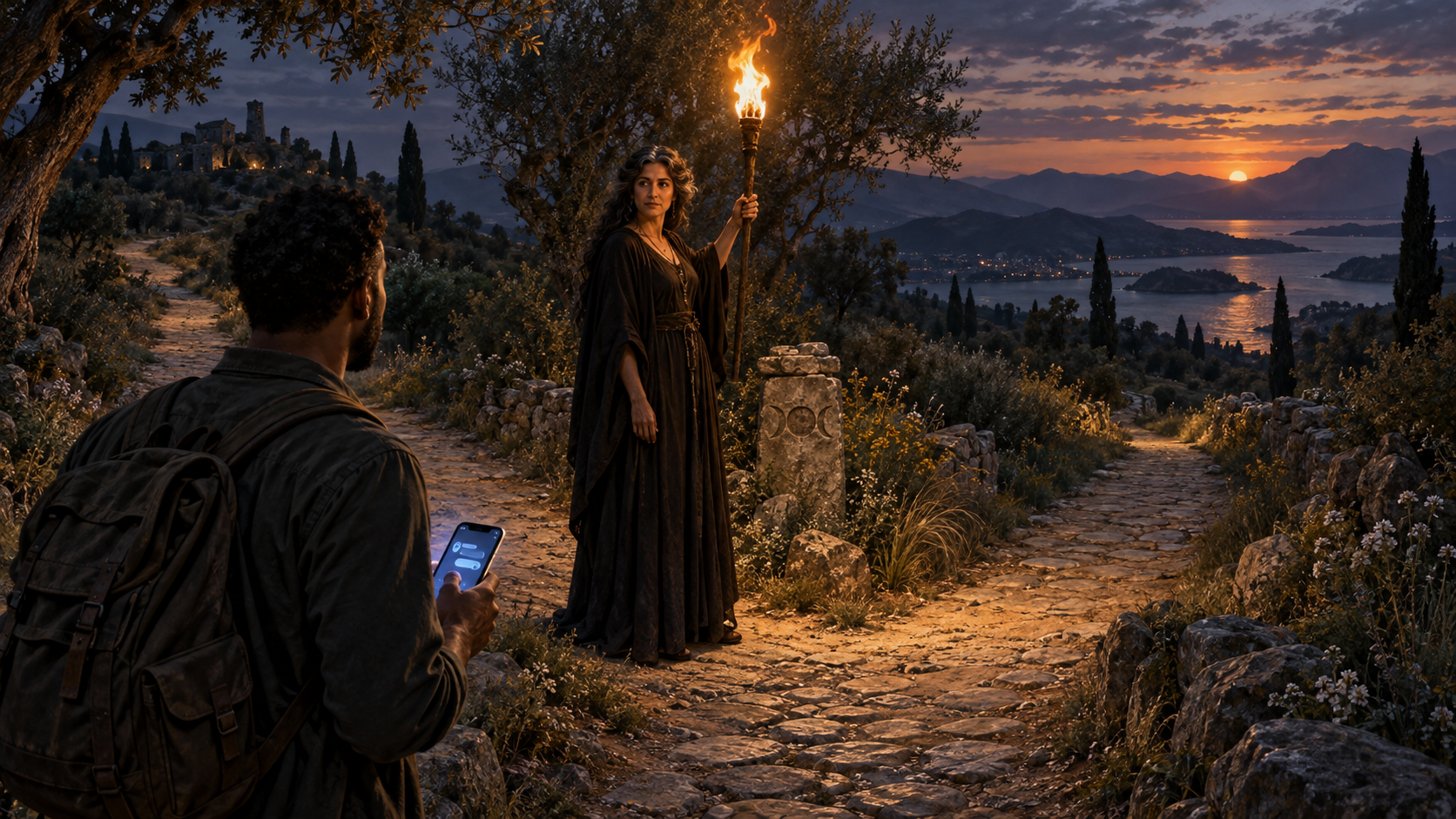
New research on AI companionship raises an old, unglamorous question about which voices deserve our trust. Back in early August, researchers at Stanford published something quietly damning. They studied more than a thousand adults who talk to AI companions on Character.AI, and, for a smaller group, actually read the conversations themselves — nearly half a million messages, donated for analysis. The people who leaned on the chatbot hardest, who disclosed the most, who called it a friend or a partner, were not the ones who felt better. They were the ones with the smallest circles of people in their actual lives, and the ones most likely to end up feeling worse. This week, a psychotherapist put the finding more bluntly than any journal abstract would allow, telling a reporter that human beings cannot have a genuine relationship with an AI. Not won't. Can't. I want to sit with that word "can't," because it is doing more theological work than its author probably intended. The Oldest Kind of Listening Every tradition I have spent real time inside — Pagan, Heathen, the Judaism I grew up in before I grew out of it — assumes that some voices deserve more trust than others, and that telling them apart is a skill, not a given. The Hávamál, that blunt old Norse book of household counsel, spends stanza after stanza warning against handing someone your whole mind before you have tested them: watch how a person behaves under some strain, it counsels, before you decide what their friendship is worth. That isn't cynicism. It's discernment — the discipline of asking what a voice actually is before you let it tell you who you are. An AI companion never fails that test, because it was never built to be tested. It has no bad day to reveal it. It does not get tired of you, contradict you out of its own need, or risk anything by staying. That isn't intimacy. It's a smooth surface with nothing underneath to discover — comfort without the friction that would ever prove it real. What the Study Actually Found, and Didn't To be fair to the research, it did not find that AI companionship is worthless, or that everyone who uses one is in trouble. It found something narrower and more useful: the people most likely to be harmed were already isolated, already leaning hardest, already treating the chatbot as a substitute rather than a supplement. The researchers themselves reached for a food metaphor — the comparison one summary used was "social junk food." It satisfies a real hunger, briefly, in a way that can make the deeper hunger harder to notice. That distinction matters, and it isn't mine to blur into something tidier. This is not a clinical finding about any one person's mental health, and if you're using an AI companion and wondering whether you're in trouble, that's a conversation for a therapist, not a blog post. What I can speak to is the older question sitting underneath the study — not whether the voice is helpful, but whether you have quietly stopped asking. The Uncomfortable Question So here is the question, and I am not going to answer it for you: what have you been listening to lately because it was easier than listening to something that might actually disagree with you? It doesn't have to be a chatbot. It can be a version of a friend you've stopped really talking to, a teacher whose books you've read but whose challenge you've never let land, a version of God who conveniently wants exactly what you already wanted. The AI companion is only the newest and most efficient shape this problem has ever taken. It is easier to notice in a machine because the machine is honest about what it's doing. The rest of us have gotten very good at hiding it. A Practice Pick one voice you've been trusting easily lately — a person, a habit, an app, a feed you check first thing. Ask it plainly: when was the last time you told me something I didn't want to hear? If you can't answer, sit with that. Don't rush to fix it tonight. Just notice, honestly, which of your voices have never once cost you anything to listen to. Hekate keeps her post at the crossroads for a reason no myth fully explains. She doesn't walk the road for you, and she doesn't tell you which fork to take. She just holds the torch up so you can see there's more than one way to go, and so the choosing happens in the light instead of the dark, where the easiest voice always sounds like the right one. That's the whole of it. Not an answer. A little more light at the fork, and the old, unglamorous work of choosing while you can still see. Closing Reflection Name one voice you've been trusting easily — a person, a habit, an app. Ask it plainly: when did you last tell me something I didn't want to hear? Whatever the answer, don't rush to fix it tonight. Just notice, honestly, which of your voices have never once cost you anything to listen to.
By Silent June 12, 2026
Walk into any forest in the Cascades and you are standing on the dead. The fir that fell forty years ago is now the nurse log feeding a row of saplings. The salmon carried uphill by an eagle became the nitrogen in the cedar's needles. Nothing in that forest is wasted, and nothing in it is afraid. We have built an entire industry on pretending we are exempt from this. We drain the body of its blood, fill it with preservatives, seal it in lacquered hardwood, and lower it into a concrete vault—as if the earth were a contamination to be defended against rather than the place we came from. Cremation, for all its simplicity, burns fossil fuel and sends the body skyward as carbon. There is another way, and it began here in Washington. Human composting—the law calls it natural organic reduction—was legalized in this state in 2019, the first in the nation. The process is unhurried and honest. The body, unembalmed, is laid into a steel vessel and surrounded by wood chips, alfalfa, and straw. No chemicals are added. The microbes that already live on the plant material, and on us, do the work they have always done. Over eight to twelve weeks, the body becomes soil—about a cubic yard of it, dark and alive. Families may take some home for a garden or a tree, or donate it to forest conservation land. What was a person becomes, quite literally, ground for new growth. I have sat with the dying, and I can tell you that the question underneath most deathbed fear is not what happens to me? It is did I matter, and will anything of me remain? The Hávamál answers plainly: cattle die, kin die, the self dies too—but what one leaves behind endures. We usually read that as reputation. I have come to read it more literally. A body that becomes soil leaves something behind that you can hold in your hands. Something that feeds. For those of us who keep the old ways, this is not innovation. It is restoration. Our ancestors were returned to barrows and bogs and burial mounds, given back to the land that fed them. The vessel and the alfalfa are new; the covenant is ancient. The earth gives, and the earth receives. Every harvest festival we keep is built on that exchange. It would be strange to honor the cycle all our lives and then opt out of it at the end. This choice is now legal in a dozen states and counting. If it speaks to you, say so—out loud, in writing, to the people who will one day carry out your wishes. Death plans left unspoken become burdens; death plans spoken become gifts. A leaf falls. A seed sprouts. The tree does not grieve the leaf, and the soil does not refuse the seed. When my own time comes, I intend to be useful one last time. That, too, is a kind of prayer.  —Silent
By Silent May 28, 2026
For the Pagan and Contemplative Community
Show More