The Hidden Cost of Being the Strongest Person in the Room
Silent • April 18, 2026

Why high-performing leaders quietly fragment under pressure

Every organization has one person everyone relies on.


If you’re reading this, there’s a good chance it’s you.


You don’t say it out loud. You don’t need to. The pattern is obvious. When something breaks, escalates, or stalls—your name comes up. Not because it’s convenient, but because it’s predictable.

You deliver.


And over time, that becomes the problem.


The Burden of Consistency

Consistency is rewarded—until it becomes an expectation you can’t step outside of.


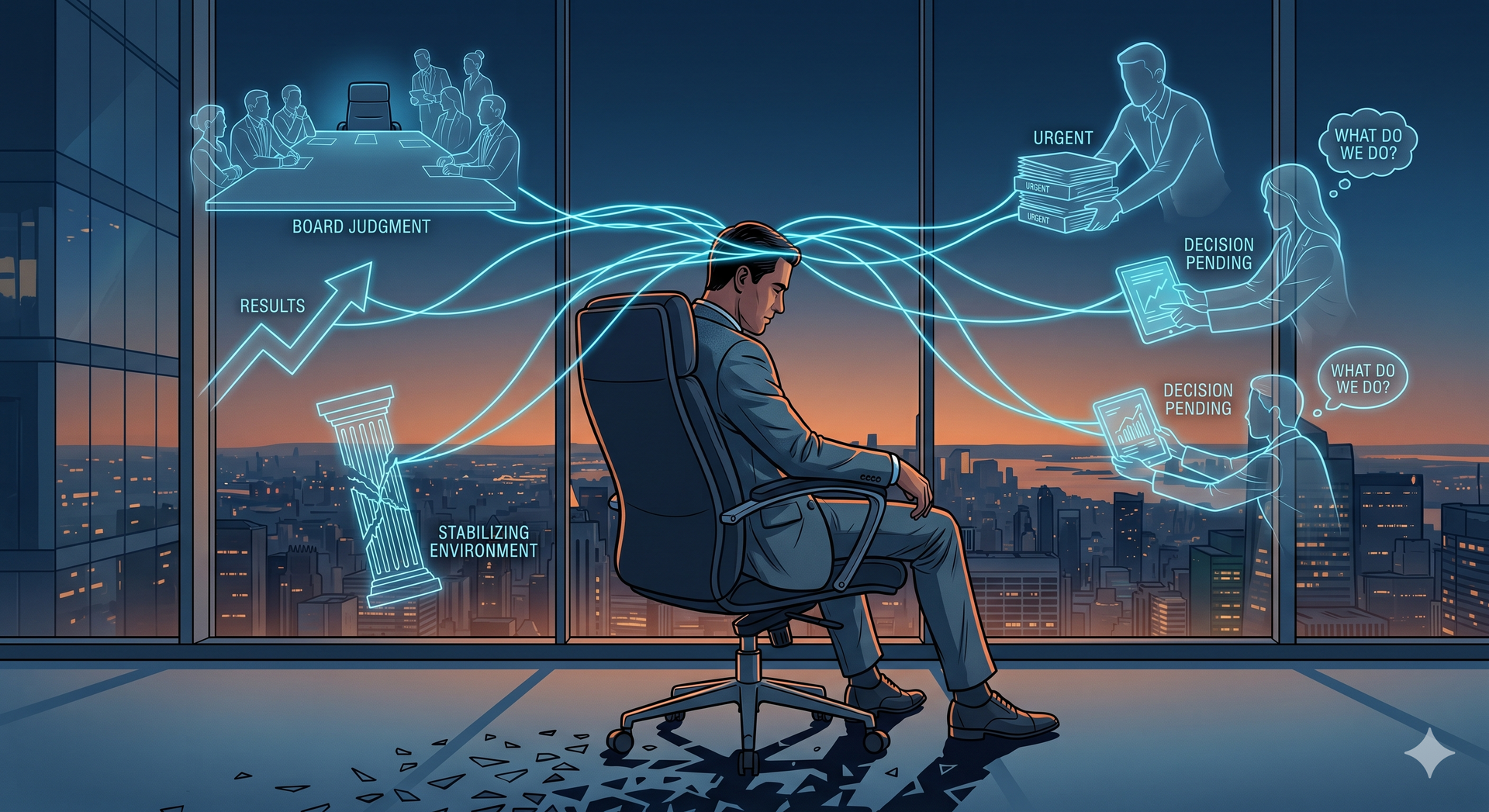
High-performing CEOs don’t just produce results. They stabilize environments. Teams organize themselves around your reliability. Boards assume your judgment will hold. Investors expect continuity.


The issue isn’t the workload. It’s the identity.


You stop being someone who performs well and become the one who cannot afford to falter.


That shift is subtle, but it changes everything. You don’t experiment the same way. You don’t speak as freely. You don’t question your own direction in public.

You become consistent at the cost of being fully present.

And no one notices—because from the outside, nothing looks broken.


The Cost of Never Breaking

There’s a quiet agreement many executives make with themselves:

“I’ll deal with it later.”

Later rarely comes.

Pressure compounds. Decisions stack. Conversations get deferred. And the internal dialogue gets shorter, sharper, more transactional.

You don’t break. You fragment.

Not visibly. Not dramatically. But in small ways:

  • You separate what you think from what you say
  • You separate what you feel from what you show
  • You separate who you are from how you lead

This fragmentation doesn’t reduce performance. In fact, it often increases it—for a while.

That’s what makes it dangerous.


Leadership Isolation

Leadership isolation isn’t about being alone. It’s about being unchallenged in the ways that matter.

You have people around you. Smart people. Capable people. But they rely on you to hold the frame.

Few will push back at the level you actually need.

Fewer will ask the question behind the question.

And almost no one will sit with you in uncertainty without trying to solve it.

So you do what you’ve always done. You think harder. Move faster. Decide sooner.

But there’s a limit to how far that goes.

Even the best operators reach a point where more thinking doesn’t create clarity—it creates noise.


Why Performance Masks Fragmentation

From the outside, everything still works.

Revenue grows. Teams execute. Strategy moves forward.

Which is why fragmentation often goes unnoticed until it shows up somewhere unexpected:

  • A decision that feels off, but you can’t explain why
  • A reaction that’s sharper than it should be
  • A sense that you’re no longer connected to the thing you built

Performance becomes a mask.

And the better you are, the harder it is to remove.

This is something I’ve seen repeatedly working with leaders driving transformation and growth at scale—people responsible for hundreds of millions in outcomes, operating in environments where there are no clean answers and no margin for hesitation.

The pattern is consistent: the external system evolves faster than the internal one.

Eventually, that gap matters.


What Real Support Looks Like

Most executives don’t need more advice.

They need space.

Not space to vent. Not space to be validated. Space to think—without performing.

Real support isn’t about motivation or frameworks. It’s about:

  • Having someone who will challenge your thinking without agenda
  • Being able to say what you actually believe, before it’s filtered
  • Slowing down enough to notice where you’re out of alignment

This isn’t soft work. It’s operational.

Because the benefit isn’t “feeling better.”
The benefit is clarity you can act on.

And clarity, at the CEO level, is leverage.


Closing

Strength without reflection becomes rigidity.

And rigidity, in leadership, looks like control right up until the moment it doesn’t.


ABOUT THE AUTHOR


Silent


Silent provides the tools for seekers to recognize their path and enables self-reliance for spiritual and magickal growth. 


Seekers gain insight from his work and find their inner calm from his ability to listen and help others reflect.


By Silent April 18, 2026
If you’re a CEO and everything looks fine on paper—but something feels off—read this. I’ve spent 30 years solving hard problems. Scaling companies. Fixing what’s broken. Driving outcomes that show up on a balance sheet. That work matters. But here’s something I didn’t expect: At a certain level, the hardest problems stop being operational. They become… personal. Not in a soft way. In a way that has real consequences: Decisions feel heavier, even when they’re correct Success stops feeling like progress Conversations get filtered because they have to And there are questions you don’t have a place to ask Not because you’re incapable. Because there’s nowhere appropriate to have them. Most leaders respond the same way: They push harder. Think longer. Stay busy. It works—until it doesn’t. I was skeptical of anything that sounded like “spiritual” work. Still am, frankly. But I’ve learned this: There are moments in leadership where the issue isn’t strategy, execution, or intelligence. It’s clarity. And clarity doesn’t come from more pressure. It comes from the right conversation. Not coaching. Not therapy. Not advice. A different kind of conversation. One where: You’re not being evaluated You’re not being managed You’re not performing Just thinking. Out loud. Clearly. If you’re in a season where: The old playbook still works—but feels incomplete The questions are getting quieter, but more persistent Or something is shifting and you can’t quite name it You’ll recognize this. I don’t post about this often. But I do have a small number of these conversations each month. Quietly. If this resonates, send me a message. No pitch. No process. Just a conversation.
By Lawrence Lerner March 24, 2026
When someone is dying, people often ask me: “What am I supposed to say?” Usually, less than you think. You do not need perfect words. You need presence that doesn’t flinch. At the bedside, simple truths are enough: “I’m here.” “I love you.” “You don’t have to do this alone.” Let silence do some of the work. If they want to talk, follow their lead. If they want quiet, protect it. If they’re afraid, don’t try to argue them out of fear. Stay with them inside it. Spiritual direction near death is not about giving answers about the afterlife. It is about helping someone stay in relationship: with their breath, their people, their meaning, their mystery. Dying people do not need speeches. They need someone who will not look away. And practical care is sacred too: water, music, dimmed lights, calling hospice, asking who they want contacted. Love often arrives as competent care. I think of a granddaughter holding her grandmother’s hand and saying only, “I’m right here.” No theology. Just contact. The room softened. Her breathing settled. When the room gets simpler—less panic, more honesty—you’re probably doing enough. And when symptoms escalate or safety is at risk, we bring in hospice or medical support immediately. What do you avoid saying because you fear emotion? Need an ear at the bedside? Let's talk
By Silent March 2, 2026
 When identity dissolves, the task isn’t to “figure it out”—it’s to stay awake long enough for the next true thing to appear. Your life can keep moving while your inner story goes quiet. That silence isn’t failure. It’s the beginning of a different kind of listening. The moment after the engine turns off I once watched someone stare at their phone in a parked car long after the engine went off. Not crying. Not scrolling. Just holding the device like it was a warm stone. Their calendar was still full—meetings, reminders, birthdays. The world kept offering appointments as if nothing had happened. The next obligation was already waiting with its clean, impersonal confidence. But inside, something had unhooked. They said, almost casually, “I don’t know what to call myself anymore.” And the way they said it—flat, honest, unadorned—felt like a threshold. The moment after a door closes, before you hear the latch. There are griefs you can name. There are endings with paperwork. And then there’s this: the quiet disappearance of a frame that used to hold your life together. The suffering beneath the suffering There’s a particular kind of suffering that doesn’t come from pain itself, but from the loss of the frame . You can survive grief, job loss, divorce, illness, disillusionment—any of the obvious endings—and still be unprepared for the quieter ending underneath: the ending of who you were in your own mind . The identity you relied on… the role that made you legible… the story that explained why you mattered… When it stops working, it’s not only sad. It’s destabilizing. Because the mind wants a replacement immediately. A new label. A plan. A five-step reinvention. A “here’s what I learned” caption. Something you can hold up like a passport and say, See? I still know who I am. But the in-between doesn’t respond to force. The in-between responds to attention. Not dramatic attention. Not “make content out of your healing” attention. The kind of attention you bring to a candle when the power is out: steady, protective, ordinary. You cup your hands around the flame. You don’t demand it become daylight. You just keep it from going out. The time between stories is not empty time. It’s compost time—where the next life learns what it can afford to forget. The lie that makes the doorway unbearable The lie is: “If I don’t know who I am, I must be doing something wrong.” So we treat confusion like a defect. We try to outrun it with productivity, self-improvement, romance, spiritual intensity, or certainty theater—anything that makes us feel like we’re “back on track.” We keep moving because stopping feels like disappearing. We keep explaining because silence feels like failure. But confusion is often an initiation. Not into a new identity you can announce. Into a deeper honesty you can inhabit. A kind of inner truth that doesn’t need applause to be real. And if you’re in this season, there’s a shift that can change everything: The question is not, “How do I get back to who I was?” The question is: “What is becoming true now that my old answers don’t work?” That question doesn’t always give immediate relief. But it makes the doorway sacred instead of shameful. What the doorway asks of you A doorway season doesn’t ask you to “figure it out.” It asks you to stay awake. To stop treating not-knowing like a personal failure. To learn the difference between: · being lost , and · being between. Lost says: I’ve done something wrong. Between says: something is changing, and I haven’t learned its shape yet. Between is honest. Between is tender. Between is where the deeper story starts to form—quietly, without your permission, like new cells knitting themselves together. The mind hates that. The soul recognizes it. A practice for the in-between: The Three-Sentence Threshold (5 minutes) Try this once today. Not to fix anything—just to locate yourself. Write three sentences. Handwritten if you can. Sentence 1 (Naming): “The old story that stopped working is: ________.” Examples: · “I am the reliable one.” · “I can earn my way into safety.” · “If I’m good, I’ll be loved.” · “I can stay numb and still be okay.” Sentence 2 (Cost): “What it cost me to keep believing that was: ________.” Time. Tenderness. Truth. Body. Relationships. Joy. Rest. Aliveness. Sentence 3 (Glimmer): “What I notice trying to be born now is: ________.” Don’t force it. Even “I don’t know yet” counts. So does: “I want to tell the truth.” “I want to stop performing.” “I want to live slower.” “I want to feel again.” Then place a hand on your sternum (or wherever you feel the most “here”) and take three slow breaths , as if you’re making room for a shy animal to come closer. Not to capture it. Just to let it know you won’t chase it away. What to notice over the next 24–72 hours For the next few days, watch for small signals. They’re easy to miss because they don’t announce themselves as “spiritual.” They show up as habits. As reflexes. As little surges of urgency. · When do you reach for a label to calm yourself? (A role, a diagnosis, a new certainty, a new persona.) · What situation makes you feel the urge to perform certainty? (Especially with family, partners, colleagues, online.) · Where does your body soften when you admit, “I don’t know”? (Your jaw. Your belly. Your shoulders. Your breath.) If you can, practice replacing “I should have this figured out” with: “I’m in a doorway season. I’m allowed to move slowly.” Not forever. Just long enough to become honest again. Because speed can be a way of staying asleep. And this season—hard as it is—might be asking you to wake up. A quiet benediction (for the between) May you stop confusing uncertainty with failure. May you learn the difference between urgency and truth. May you be protected from the false comfort of quick answers. May the next real thing arrive in its own time— and may you be here to meet it. Invitation If you’re in that doorway season, I won’t rush you toward a solution. I won’t hand you a shiny new identity to wear like armor. I’ll sit with you in the honest middle and help you listen for what’s actually true—beneath fear, habit, inherited beliefs, and the pressure to look “fine.” Reflection question (for comments/replies): Where do you feel the pressure to name yourself too quickly—and what would happen if you didn’t? CTA (verbatim): “Reply with one sentence: What are you carrying that no one is helping you carry?” Optional: “If you want help finding the next faithful step, reply CHAIR, and I’ll send a link for a 15-minute fit call.” “This isn’t therapy or medical advice; it’s spiritual companionship and integration support. If you’re in crisis, seek clinical care.”
Show More